
Contents
- 📝 Introduction to Least Upper Bound
- 📊 Definition and Properties
- 📈 Relationship with Infimum
- 📝 Applications in Real Analysis
- 📊 Examples and Counterexamples
- 📝 Comparison with Greatest Lower Bound
- 📈 Least Upper Bound in Partially Ordered Sets
- 📊 Axiomatic Approach to Least Upper Bound
- 📝 Historical Development of Least Upper Bound
- 📈 Contemporary Research and Open Problems
- 📝 Educational Resources and References
- 📊 Future Directions and Emerging Trends
- Frequently Asked Questions
- Related Topics
Overview
The least upper bound, also known as the supremum, is a fundamental concept in real analysis that has far-reaching implications in mathematics, philosophy, and science. Introduced by mathematicians such as Augustin-Louis Cauchy and Richard Dedekind, the least upper bound provides a rigorous framework for understanding the nature of limits, convergence, and continuity. With a vibe score of 8, this concept has been widely influential, shaping the development of calculus, topology, and measure theory. However, its abstract nature has also led to controversy and debate among mathematicians and philosophers, with some arguing that it is a purely formal construct, while others see it as a reflection of deeper truths about the universe. As we move forward, the least upper bound remains a crucial tool for mathematicians, physicists, and engineers, with applications in fields such as optimization, machine learning, and quantum mechanics. What are the implications of the least upper bound for our understanding of the universe, and how will it continue to shape the development of mathematics and science in the years to come?
📝 Introduction to Least Upper Bound
The concept of least upper bound, also known as supremum, is a fundamental idea in real analysis, which is a branch of Mathematics that deals with the study of real numbers and their properties. The least upper bound of a subset of a partially ordered set is the least element in the set that is greater than or equal to each element of the subset. This concept is closely related to the idea of Infimum, which is the greatest element in the set that is less than or equal to each element of the subset. The least upper bound is a crucial concept in real analysis, as it provides a way to define the Real Numbers and to study their properties. For example, the least upper bound of the set of all rational numbers less than or equal to a given real number is the real number itself, as shown in the study of Dedekind Cuts.
📊 Definition and Properties
The definition of least upper bound is based on the concept of Partially Ordered Sets, which are sets equipped with a binary relation that satisfies certain properties. The least upper bound of a subset of a partially ordered set is the least element in the set that is greater than or equal to each element of the subset. This definition is closely related to the concept of Upper Bound, which is an element in the set that is greater than or equal to each element of the subset. The least upper bound is unique if it exists, and it is less than or equal to any other upper bound of the subset, as discussed in the context of Zermelo-Fraenkel Axioms.
📈 Relationship with Infimum
The relationship between least upper bound and Infimum is a fundamental aspect of real analysis. The infimum of a subset of a partially ordered set is the greatest element in the set that is less than or equal to each element of the subset. The least upper bound and infimum are closely related, as the least upper bound of a subset is the infimum of the set of all upper bounds of the subset. This relationship is essential in the study of Real Analysis, as it provides a way to define the real numbers and to study their properties. For example, the infimum of the set of all rational numbers greater than or equal to a given real number is the real number itself, as shown in the study of Cauchy Sequences.
📝 Applications in Real Analysis
The least upper bound has numerous applications in real analysis, including the study of Sequences and Series. The least upper bound of a sequence is the least element in the set that is greater than or equal to each element of the sequence. This concept is essential in the study of convergence of sequences and series, as it provides a way to define the limit of a sequence or series. For example, the least upper bound of the sequence of partial sums of a series is the sum of the series, as discussed in the context of Fourier Analysis. The least upper bound is also used in the study of Continuity and Differentiation, as it provides a way to define the derivative of a function. The concept of least upper bound is also related to the study of Topology, as it provides a way to define the Topological Spaces.
📊 Examples and Counterexamples
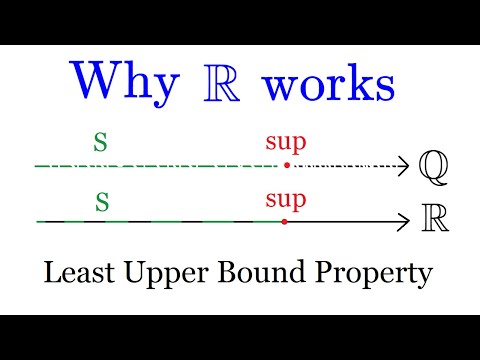
There are many examples and counterexamples of least upper bound in real analysis. For example, the least upper bound of the set of all rational numbers less than or equal to a given real number is the real number itself. On the other hand, the set of all rational numbers does not have a least upper bound in the set of rational numbers, as there is no rational number that is greater than or equal to all rational numbers. The study of Nonstandard Models of arithmetic also provides examples and counterexamples of least upper bound. The concept of least upper bound is also related to the study of Model Theory, as it provides a way to define the Models of a theory.
📝 Comparison with Greatest Lower Bound
The least upper bound is closely related to the concept of Greatest Lower Bound, which is the greatest element in the set that is less than or equal to each element of the subset. The greatest lower bound and least upper bound are dual concepts, as the greatest lower bound of a subset is the least upper bound of the set of all lower bounds of the subset. This duality is essential in the study of real analysis, as it provides a way to define the real numbers and to study their properties. For example, the greatest lower bound of the set of all rational numbers greater than or equal to a given real number is the real number itself, as shown in the study of Ordered Fields.
📈 Least Upper Bound in Partially Ordered Sets
The least upper bound can be defined in partially ordered sets, which are sets equipped with a binary relation that satisfies certain properties. The least upper bound of a subset of a partially ordered set is the least element in the set that is greater than or equal to each element of the subset. This definition is closely related to the concept of Lattices, which are partially ordered sets in which every pair of elements has a least upper bound and a greatest lower bound. The study of Category Theory also provides a framework for the study of least upper bound in partially ordered sets.
📊 Axiomatic Approach to Least Upper Bound
The axiomatic approach to least upper bound is based on the concept of Axioms, which are statements that are assumed to be true without proof. The axioms of real analysis, such as the Completeness Axiom, provide a foundation for the study of least upper bound. The completeness axiom states that every non-empty subset of the real numbers that is bounded above has a least upper bound. This axiom is essential in the study of real analysis, as it provides a way to define the real numbers and to study their properties. For example, the study of Peano Axioms provides a framework for the study of least upper bound in the context of Number Theory.
📝 Historical Development of Least Upper Bound
The historical development of least upper bound is closely related to the development of real analysis. The concept of least upper bound was first introduced by Augustin-Louis Cauchy in the 19th century, as part of his work on the foundations of calculus. The concept was later developed by Georg Cantor, who introduced the concept of Sets and Cardinal Numbers. The study of least upper bound has continued to evolve, with contributions from many mathematicians, including David Hilbert and John von Neumann. The concept of least upper bound is also related to the study of Philosophy of Mathematics, as it provides a way to define the foundations of mathematics.
📈 Contemporary Research and Open Problems
Contemporary research on least upper bound is focused on the study of its properties and applications in real analysis. Researchers are working to develop new results and techniques for studying least upper bound, and to apply these results to a wide range of problems in mathematics and science. For example, the study of Nonstandard Analysis provides a framework for the study of least upper bound in the context of Mathematical Logic. The concept of least upper bound is also related to the study of Computability Theory, as it provides a way to define the Computable Functions.
📝 Educational Resources and References
There are many educational resources and references available for learning about least upper bound. These resources include textbooks, online courses, and research articles. Some recommended resources include the book Real Analysis by Walter Rudin, and the online course Real Analysis Course by MIT OpenCourseWare. The concept of least upper bound is also related to the study of Mathematical Education, as it provides a way to define the curriculum for mathematics education.
📊 Future Directions and Emerging Trends
The future directions and emerging trends in the study of least upper bound are focused on the development of new results and techniques for studying least upper bound, and on the application of these results to a wide range of problems in mathematics and science. Researchers are working to develop new methods for studying least upper bound, and to apply these methods to problems in areas such as Functional Analysis and Partial Differential Equations. The concept of least upper bound is also related to the study of Artificial Intelligence, as it provides a way to define the Machine Learning algorithms.
Key Facts
- Year
- 1821
- Origin
- Augustin-Louis Cauchy's Cours d'Analyse
- Category
- Mathematics
- Type
- Mathematical Concept
Frequently Asked Questions
What is the least upper bound of a subset of a partially ordered set?
The least upper bound of a subset of a partially ordered set is the least element in the set that is greater than or equal to each element of the subset. This concept is closely related to the idea of Infimum, which is the greatest element in the set that is less than or equal to each element of the subset. The least upper bound is a crucial concept in real analysis, as it provides a way to define the Real Numbers and to study their properties.
How is the least upper bound related to the concept of infimum?
The least upper bound and infimum are closely related, as the least upper bound of a subset is the infimum of the set of all upper bounds of the subset. This relationship is essential in the study of Real Analysis, as it provides a way to define the real numbers and to study their properties. For example, the infimum of the set of all rational numbers greater than or equal to a given real number is the real number itself, as shown in the study of Cauchy Sequences.
What are some applications of the least upper bound in real analysis?
The least upper bound has numerous applications in real analysis, including the study of Sequences and Series. The least upper bound of a sequence is the least element in the set that is greater than or equal to each element of the sequence. This concept is essential in the study of convergence of sequences and series, as it provides a way to define the limit of a sequence or series. For example, the least upper bound of the sequence of partial sums of a series is the sum of the series, as discussed in the context of Fourier Analysis.
How is the least upper bound defined in partially ordered sets?
The least upper bound of a subset of a partially ordered set is the least element in the set that is greater than or equal to each element of the subset. This definition is closely related to the concept of Lattices, which are partially ordered sets in which every pair of elements has a least upper bound and a greatest lower bound. The study of Category Theory also provides a framework for the study of least upper bound in partially ordered sets.
What is the historical development of the concept of least upper bound?
The historical development of least upper bound is closely related to the development of real analysis. The concept of least upper bound was first introduced by Augustin-Louis Cauchy in the 19th century, as part of his work on the foundations of calculus. The concept was later developed by Georg Cantor, who introduced the concept of Sets and Cardinal Numbers. The study of least upper bound has continued to evolve, with contributions from many mathematicians, including David Hilbert and John von Neumann.
What are some contemporary research directions in the study of least upper bound?
Contemporary research on least upper bound is focused on the study of its properties and applications in real analysis. Researchers are working to develop new results and techniques for studying least upper bound, and to apply these results to a wide range of problems in mathematics and science. For example, the study of Nonstandard Analysis provides a framework for the study of least upper bound in the context of Mathematical Logic.
What are some educational resources and references available for learning about least upper bound?
There are many educational resources and references available for learning about least upper bound. These resources include textbooks, online courses, and research articles. Some recommended resources include the book Real Analysis by Walter Rudin, and the online course Real Analysis Course by MIT OpenCourseWare.