
Contents
Overview
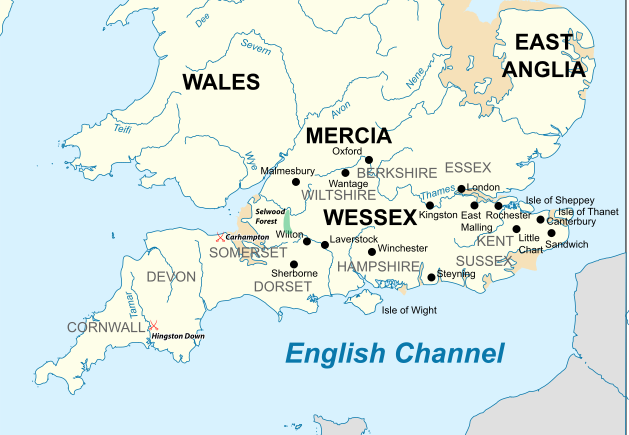
The origins of the Kingdom of Wessex are shrouded in the mists of legend, with tradition attributing its founding to Cerdic and his son Cynric of the Gewisse around 519 AD. Early historical accounts, primarily the Anglo-Saxon Chronicle and the West Saxon Genealogical Regnal List, paint a picture of a kingdom gradually expanding its territory from its initial base in the Hampshire region. Wessex was one of the seven major Anglo-Saxon kingdoms, often referred to as the Heptarchy, and its early history is marked by conflicts with neighboring kingdoms like Mercia and Welsh principalities. A pivotal moment arrived with the baptism of King Cenwalh around 642 AD, marking Wessex's formal embrace of Christianity and its integration into the broader European religious and political landscape. The kingdom's strategic position and the resilience of its rulers, particularly during the intense Viking Age, would ultimately propel it to preeminence.
⚙️ How It Worked
Wessex operated as a feudal monarchy, with the king at its apex, wielding significant military, judicial, and administrative power. The kingdom's governance relied on a system of ealdormen and thegns who administered regions and commanded local levies. The capital city of Winchester served as the royal seat and a vital administrative and ecclesiastical center. The West Saxon dialect of Old English, known as West Saxon, became the dominant literary language of the period, preserved in numerous manuscripts. The kingdom's legal framework was codified, with laws issued by kings like Alfred the Great and his successors, reflecting a blend of Germanic customary law and Christian principles. Its military structure evolved significantly, especially under Alfred, who established a standing army and a network of fortified burhs to counter Viking threats.
📊 Key Facts & Numbers
Wessex's economy was primarily agrarian, with trade conducted using sceattas and later silver pennies. The Anglo-Saxon Chronicle, a vital historical source, was initiated in Wessex around 890 AD, with multiple copies distributed across the kingdom. By the time of its dissolution in 927 AD, Wessex had successfully integrated the territories of Northumbria, East Anglia, and Mercia into a unified English realm.
👥 Key People & Organizations
The most celebrated figure of Wessex is undoubtedly Alfred the Great (r. 871–899), who successfully defended his kingdom against the Great Heathen Army and fostered a renaissance in learning and culture. His son, Edward the Elder (r. 899–924), continued his father's work, expanding Wessex's control. Edward's son, Æthelstan (r. 924–939), is credited with being the first true King of the English, conquering the Viking Kingdom of York in 927. Other significant rulers include Cenwalh (r. 642–645, 648–672), who oversaw Wessex's conversion to Christianity, and Ine (r. 688–726), who issued one of the earliest surviving West Saxon law codes. The Church of England played a crucial role, with bishops like Alfred of Sherborne and Wulfstan of York influencing both religious and political affairs.
🌍 Cultural Impact & Influence
The Kingdom of Wessex left an indelible mark on the cultural and political landscape of Britain. Its most profound legacy is the foundation of the unified Kingdom of England, a process largely completed by Æthelstan. The West Saxon dialect of Old English, championed by Alfred the Great, became the standard for much of English literature, influencing the development of the modern English language. The legal and administrative structures established in Wessex, including the system of burhs (fortified towns), provided a blueprint for later governance. Winchester, as its capital, became a symbol of English royal authority for centuries. The very concept of 'Englishness' owes a significant debt to the struggle for survival and eventual dominance waged by the kings of Wessex against external threats, particularly the Vikings.
⚡ Current State & Latest Developments
While the Kingdom of Wessex ceased to exist as a distinct political entity in 927 AD, its historical significance continues to resonate. Archaeological excavations at sites like Winchester and Old Sarum regularly unearth artifacts that shed new light on daily life, governance, and military strategies of the period. Modern scholarship, aided by advancements in archaeology and linguistics, continues to refine our understanding of Wessex's social structures, economic practices, and religious beliefs. The ongoing debate surrounding the precise origins of Wessex and the historicity of figures like Cerdic highlights the dynamic nature of historical research in this era. The enduring appeal of figures like Alfred the Great is evident in popular culture, with numerous books, films, and television series exploring his reign and the era.
🤔 Controversies & Debates
The historicity of Wessex's founding figures, Cerdic and Cynric, remains a point of contention among historians. Some scholars view the accounts in the Anglo-Saxon Chronicle as legendary, possibly retroactively constructed to legitimize the West Saxon royal line. The exact nature of the relationship between Wessex and other Anglo-Saxon kingdoms, particularly Mercia and Welsh polities, is also debated, with varying interpretations of the extent of West Saxon dominance before Alfred. Furthermore, the process of unification under Æthelstan is sometimes viewed as a conquest rather than a consensual integration, with debates over the degree of autonomy retained by former kingdoms like Northumbria. The extent to which Alfred the Great's reforms were truly innovative versus building upon existing structures is another area of scholarly discussion.
🔮 Future Outlook & Predictions
The future study of Wessex will likely be driven by continued archaeological discoveries and the application of new analytical techniques. Advances in paleogenetics could offer insights into the population movements and ethnic makeup of early Wessex. Computational linguistics may further illuminate the nuances of the West Saxon dialect and its evolution. The narrative of Wessex's rise to power and its role in forging England is likely to remain a cornerstone of British historical identity, though interpretations may shift with new evidence. The enduring fascination with Alfred the Great suggests that popular interest will continue to fuel new media adaptations and historical tourism, potentially shaping public perception of the period.
💡 Practical Applications
While the Kingdom of Wessex itself is a historical entity, its legacy has practical applications in understanding the development of governance, law, and language. The principles of decentralized administration through burhs and the codified legal system influenced subsequent English governance. The study of West Saxon literature provides invaluable insights into the evolution of the English language, offering a foundation for understanding etymology and linguistic change. Furthermore, the historical narrative of Wessex's resistance against invasion and its eventual unification serves as a powerful case study in nation-building and the consolidation of political power, relevant to understanding similar processes in other historical and contemporary contexts. Archaeological sites associated with Wessex continue to be vital for heritage tourism and education.
Key Facts
- Category
- history
- Type
- topic