
Contents
Overview
The integral test for convergence, also known as the Maclaurin–Cauchy test, emerged from the burgeoning field of calculus in the early 18th century. Colin Maclaurin, a Scottish mathematician, and Augustin-Louis Cauchy, a French mathematician, independently developed this method. Their work aimed to rigorously establish the convergence properties of infinite series, a topic that had gained significant traction with the work of Gottfried Wilhelm Leibniz and Isaac Newton. Prior to this, many mathematicians relied on intuition or less formal arguments. The test's formalization provided a concrete link between discrete summation and continuous integration, a cornerstone of real analysis. Maclaurin's contribution predates Cauchy's by nearly a century, though Cauchy's presentation in his Cours d'Analyse (1821) is often cited as the definitive formulation.
⚙️ How It Works
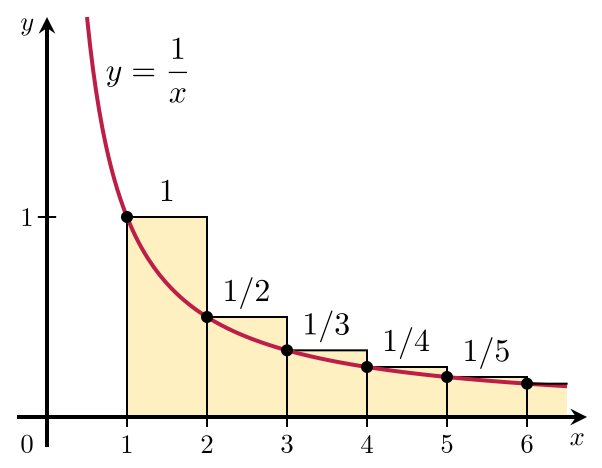
The integral test operates on a simple yet profound principle: comparing the sum of a series to the area under a curve. For an infinite series $\sum_{n=N}^{\infty} a_n$ to be tested, the terms $a_n$ must correspond to a function $f(x)$ that is positive, continuous, and decreasing for all $x \ge N$. The test states that the series $\sum_{n=N}^{\infty} a_n$ converges if and only if the improper integral $\int_{N}^{\infty} f(x) dx$ converges. This means if the area under the curve $f(x)$ from $N$ to infinity is finite, the sum of the series' terms is also finite, and vice versa. The choice of $N$ is flexible, as altering the first finite number of terms in a series does not affect its convergence or divergence. This equivalence is visualized by approximating the area of rectangles under the curve with the area under the curve itself, using appropriate bounds.
📊 Key Facts & Numbers
The integral test is particularly effective for series related to p-series, which take the form $\sum_{n=1}^{\infty} \frac{1}{n^p}$. For these series, the integral test shows convergence when $p > 1$ and divergence when $p \le 1$. For instance, the harmonic series ($\sum_{n=1}^{\infty} \frac{1}{n}$), where $p=1$, diverges, mirroring the divergence of $\int_{1}^{\infty} \frac{1}{x} dx$. Conversely, the series $\sum_{n=1}^{\infty} \frac{1}{n^2}$ (where $p=2$) converges, as does $\int_{1}^{\infty} \frac{1}{x^2} dx$. The value of the integral $\int_{1}^{\infty} \frac{1}{x^p} dx$ is $\frac{1}{p-1}$ for $p > 1$. This means the sum of the Basel problem series, $\sum_{n=1}^{\infty} \frac{1}{n^2}$, converges to $\frac{\pi^2}{6} \approx 1.645$, a result first proven by Leonhard Euler in 1734.
👥 Key People & Organizations
The primary architects of the integral test are Colin Maclaurin (1698–1746) and Augustin-Louis Cauchy (1789–1857). Maclaurin, a protégé of Brook Taylor, made significant contributions to calculus and series expansion, including the Maclaurin series, a special case of the Taylor series. Cauchy, one of the most prolific mathematicians of the 19th century, rigorously formalized many concepts in calculus and complex analysis, including the conditions for convergence. While Maclaurin developed the core idea earlier, Cauchy's systematic approach in his Cours d'Analyse solidified its place in standard mathematical curricula. Other mathematicians like Leonhard Euler utilized similar concepts implicitly when evaluating specific series, such as the Basel problem.
🌍 Cultural Impact & Influence
The integral test has profoundly influenced the teaching and understanding of calculus and real analysis worldwide. It serves as a crucial pedagogical tool, bridging the intuitive geometric concept of area with the abstract notion of infinite sums. Its application in introductory calculus courses has been standard for generations, shaping how students first grapple with the convergence of series. Beyond academia, the principles underpinning the integral test are foundational to fields requiring the analysis of continuous processes and discrete data, such as signal processing, economics, and physics, where understanding the cumulative effect of many small contributions is essential. The test's elegance and directness make it a recurring motif in mathematical literature and problem-solving.
⚡ Current State & Latest Developments
In contemporary mathematics, the integral test remains a standard topic in undergraduate Calculus II and real analysis courses. While more advanced convergence tests exist, such as the ratio test, root test, and comparison tests, the integral test offers a unique geometric intuition. Recent developments in computational mathematics and numerical analysis often involve algorithms that approximate integrals and series sums, indirectly building upon the foundational relationship established by the integral test. Discussions in pedagogical circles continue regarding the most effective ways to introduce and apply the test, ensuring students grasp its conditions and limitations, particularly the requirement for the function to be decreasing.
🤔 Controversies & Debates
A primary point of contention, though more a matter of careful application than a true debate, is ensuring the function $f(x)$ is indeed positive, continuous, and decreasing for $x \ge N$. If these conditions are not met, the test is invalid. For example, the series $\sum_{n=1}^{\infty} \frac{1}{n \ln(n)}$ cannot be tested directly using the integral test because the function $f(x) = \frac{1}{x \ln(x)}$ is not decreasing for all $x \ge 1$. While this series does diverge, the integral test is not the appropriate tool. Some pedagogical debates arise over whether the integral test should be taught before or after other convergence tests, given its reliance on improper integrals.
🔮 Future Outlook & Predictions
The future of the integral test is likely one of continued pedagogical relevance rather than groundbreaking theoretical advancement. As mathematics education evolves, educators may explore more dynamic visualizations or computational tools to illustrate the test's principles, perhaps integrating it with interactive simulations of area approximations. While the core mathematical concept is unlikely to change, its presentation and application in new technological contexts could evolve. The test's enduring utility lies in its ability to connect disparate mathematical ideas, a quality that ensures its place in the mathematical toolkit for the foreseeable future, potentially finding novel applications in emerging fields that require analysis of discrete-to-continuous transformations.
💡 Practical Applications
The most direct application of the integral test is in determining the convergence of infinite series, particularly those that resemble functions integrable by standard calculus techniques. This is most famously seen with p-series like $\sum_{n=1}^{\infty} \frac{1}{n^p}$, where the test definitively proves convergence for $p>1$ and divergence for $p \le 1$. It's also used for series like $\sum_{n=2}^{\infty} \frac{1}{n \ln(n)}$, which diverges, and $\sum_{n=2}^{\infty} \frac{1}{n \ln^2(n)}$, which converges, by comparing them to $\int \frac{1}{x \ln^p(x)} dx$. This test is invaluable in number theory and analysis for classifying the behavior of series that arise in various mathematical problems.
Key Facts
- Category
- science
- Type
- topic