
Contents
Overview
The genesis of Ingenuity can be traced back to early conceptual studies within NASA exploring the possibility of aerial vehicles for planetary exploration. The formal development began in earnest around 2014, driven by a desire to overcome the limitations of ground-based rovers, particularly in navigating challenging Martian terrain. JPL, in collaboration with AeroVironment, took the lead, with significant contributions from NASA's Ames Research Center and Langley Research Center. Components were also supplied by Lockheed Martin Space, Qualcomm, and SolAero. Ingenuity was delivered to Mars on February 18, 2021, attached to the belly of the Perseverance rover, and successfully executed its first flight on April 19, 2021, at the Octavia E. Butler Landing site within Jezero Crater.
⚙️ How It Works
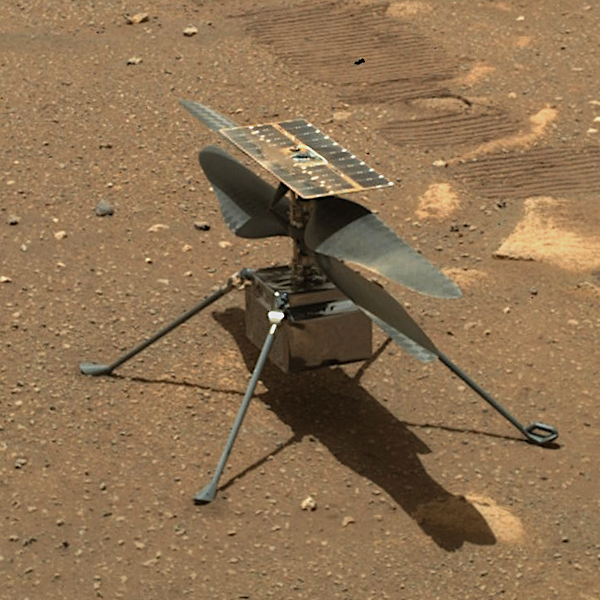
Ingenuity's design is a marvel of miniaturization and robust engineering, built to withstand the harsh Martian environment. It features counter-rotating blades, each spanning about 1.2 meters (4 feet), spinning at a rapid 2,400 revolutions per minute to generate lift in the thin Martian atmosphere, which is about 1% as dense as Earth's. The helicopter is powered by six lithium-ion batteries and relies on a solar panel on its top to recharge between flights. Navigation is handled by an onboard computer running Red Hat Enterprise Linux, utilizing sensors like an altimeter, cameras, and an inertial measurement unit. Flight plans are uploaded from JPL on Earth, and Ingenuity autonomously executes these commands, landing and taking off from a designated 'airfield' cleared by the Perseverance rover.
📊 Key Facts & Numbers
Ingenuity completed an astonishing 72 flights, far surpassing its initial design goal of just five. Its longest flight covered a distance of 1,270 meters (4,167 feet) and lasted 169.1 seconds. The helicopter operated for 975 Martian sols (days), equivalent to about 997 Earth days, from its landing in February 2021 until its mission concluded in January 2024. During its operational life, it logged approximately 2 hours and 17 minutes of flight time, covering a total distance of over 21 kilometers (13 miles). The mission cost an estimated $85 million, a fraction of the cost of larger robotic missions, demonstrating a high return on investment.
👥 Key People & Organizations
The Ingenuity project was spearheaded by a dedicated team at NASA's Jet Propulsion Laboratory (JPL). Key figures include MiMi Aung, the project manager who led the engineering team, and Håkan Kayal, a lead engineer. Bob Ballard was instrumental in the early conceptualization. AeroVironment provided critical expertise in designing and building the lightweight airframe and rotor system. Lockheed Martin Space contributed the landing gear and other structural components. Qualcomm provided the Snapdragon processor that served as Ingenuity's 'brain,' and SolAero supplied the solar cells for its power system. The Perseverance rover team at JPL was also crucial for deployment and operational support.
🌍 Cultural Impact & Influence
Ingenuity's success resonated globally, capturing the public imagination and inspiring a new generation of engineers and scientists. Its flights provided breathtaking aerial perspectives of the Martian landscape, offering unprecedented views of Jezero Crater and its geological features, which were shared widely across NASA's platforms and international media. The helicopter's achievements have been celebrated as a significant milestone in human exploration, akin to the Wright brothers' first flight. It has become a symbol of innovation and perseverance, demonstrating that even in the most challenging environments, human ingenuity can achieve the seemingly impossible, influencing science fiction narratives and public perception of space exploration.
⚡ Current State & Latest Developments
Ingenuity's operational mission officially concluded in January 2024 after it sustained rotor damage during a landing. Despite the damage, the helicopter had already far exceeded its planned mission duration and objectives. Prior to its final landing, it had successfully completed 72 flights, demonstrating the viability of aerial exploration on Mars. While Ingenuity is no longer capable of flight, its legacy continues. The data and experience gained from its operations are invaluable for the design of future Martian aerial vehicles, such as the Dragonfly rotorcraft planned for Saturn's moon Titan. Its final resting place is on the Martian surface, a testament to its groundbreaking journey.
🤔 Controversies & Debates
The primary 'controversy' surrounding Ingenuity, if it can be called that, is less about debate and more about the sheer astonishment at its success. Some initial skepticism existed regarding the feasibility of flight in the thin Martian atmosphere, a challenge that had previously deterred such missions. However, Ingenuity's consistent performance and numerous successful flights have largely silenced these doubts. The debate now centers on the implications of its success: how quickly can we deploy more advanced aerial explorers, and what new scientific questions can they help answer? There's also a discussion about the balance between robotic and human exploration, with Ingenuity highlighting the unique advantages of aerial platforms.
🔮 Future Outlook & Predictions
The future of aerial exploration on Mars and beyond is inextricably linked to Ingenuity's legacy. Building on its success, NASA and other space agencies are actively developing more sophisticated rotorcraft and winged vehicles for planetary exploration. Future missions could see larger, more capable helicopters or even fixed-wing aircraft capable of longer-duration flights, greater payload capacity, and more advanced scientific instrumentation. The principles demonstrated by Ingenuity are foundational for potential missions to other worlds with atmospheres, such as Venus, Titan, and even exoplanets. The ultimate goal is to create a 'Mars aerial network' for comprehensive reconnaissance and support for future human missions.
💡 Practical Applications
Ingenuity's primary practical application was to prove the concept of powered flight on Mars, a critical step for future exploration. Its success opens doors for aerial reconnaissance, allowing future missions to survey vast areas of terrain quickly, identify scientifically interesting targets, scout safe landing zones for future missions, and even transport small payloads. Imagine future helicopters mapping subsurface ice deposits or exploring the interiors of lava tubes. Beyond Mars, the technology and operational experience gained are directly applicable to designing aerial vehicles for other planetary bodies with atmospheres, such as Titan with its dense atmosphere, or even for atmospheric sampling on Venus.
Key Facts
- Category
- technology
- Type
- product