
Contents
Overview
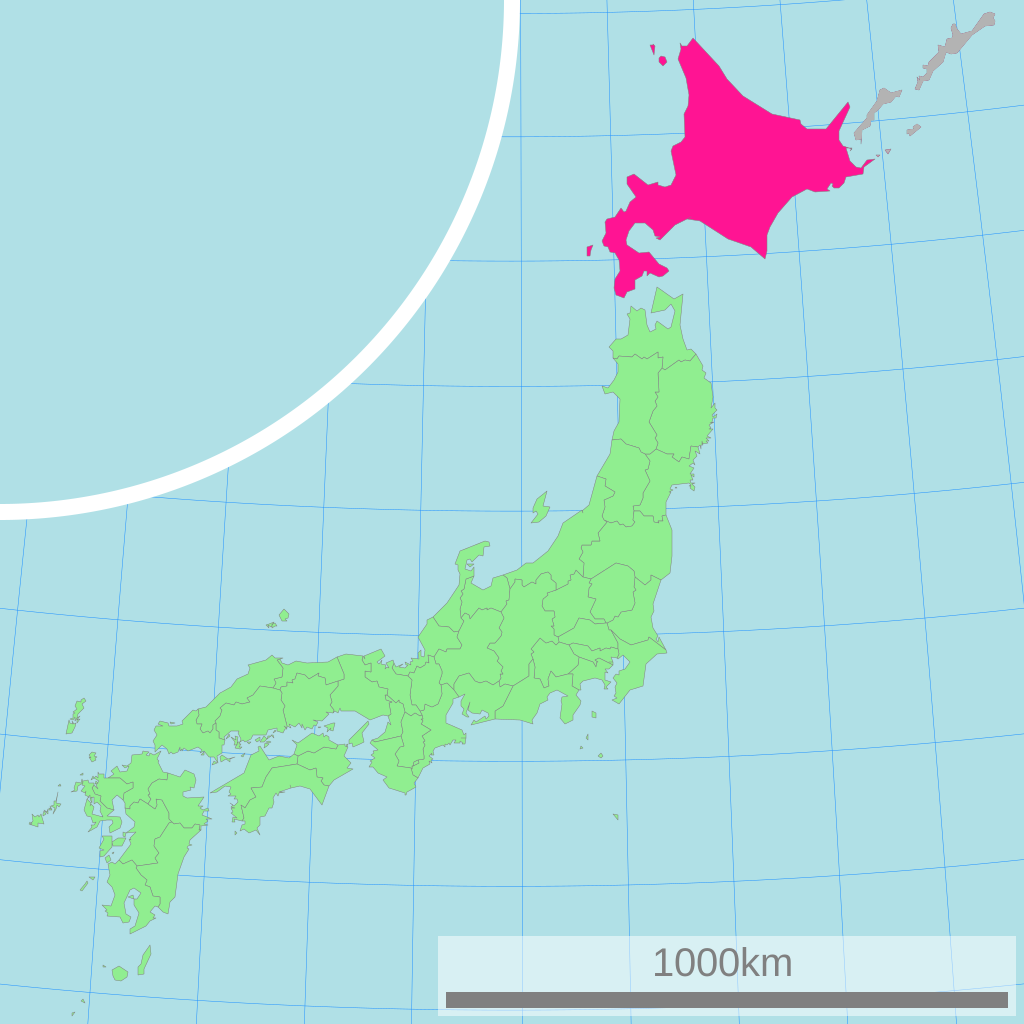
The genesis of the Hokkaido Wildlife Research Center can be traced back to the mid-20th century, a period marked by growing awareness of environmental degradation across Japan. While specific founding dates for the center itself are often intertwined with broader governmental and academic initiatives, its roots lie in the post-war era's push for scientific understanding of Japan's natural resources. Early efforts focused on cataloging Hokkaido's rich fauna, particularly species impacted by industrialization and habitat loss. The establishment of Hokkaido as a distinct administrative region, separate from the main island of Honshu, provided a unique context for focused research. Over the decades, the center evolved, formalizing its structure and expanding its mandate to include active conservation programs, often supported by the Ministry of the Environment, Japan and local prefectural governments. The center has established dedicated research facilities near Daisetsuzan National Park and the initiation of long-term monitoring projects for key species.
⚙️ How It Works
The operational framework of the Hokkaido Wildlife Research Center is built upon a multi-disciplinary approach to wildlife science. Researchers employ a range of methodologies, from field-based observation and tracking using GPS collars and drone technology, to laboratory analysis of genetic material and ecological samples. The center's work involves extensive fieldwork across Hokkaido's diverse landscapes, including its national parks like Shikotsu-Toya National Park and Akan-Mashu National Park. Data collected is analyzed using advanced statistical models and GIS to understand population dynamics, habitat use, and the impact of environmental changes. Collaboration is a cornerstone, with the center frequently partnering with Hokkaido University's Faculty of Agriculture and Faculty of Environmental Science, as well as international research institutions, to share expertise and resources. Public outreach and education programs are also integral, aiming to foster a greater appreciation for wildlife conservation among local communities and visitors.
📊 Key Facts & Numbers
The Hokkaido Wildlife Research Center's impact is quantifiable through its extensive data collection and conservation successes. Research has contributed to the recovery of the red-crowned crane population, which has seen a significant increase from a low of around 10 individuals in the 1950s to over 1,500 today, thanks in part to conservation efforts informed by the center's work. Annual surveys track the migration patterns of thousands of whooper swans, providing critical data for international conservation agreements. The center's habitat restoration projects have successfully revitalized over 500 hectares of critical wildlife corridors, directly benefiting species such as the Ezo red fox and various endemic bird species. Furthermore, over 5,000 educational materials have been distributed annually to schools and community groups, reaching an estimated 10,000 individuals each year.
👥 Key People & Organizations
Several key individuals and organizations have been instrumental in shaping the Hokkaido Wildlife Research Center's trajectory. While specific founding directors may be difficult to pinpoint without direct institutional records, prominent figures in Hokkaido wildlife research, such as Professor Emeritus Kenji Kaji of Hokkaido University, have provided significant academic leadership and mentorship. The Wildlife Conservation Society and the Japan Wildlife Research Center are key partner organizations that have provided funding, expertise, and collaborative frameworks. Local government bodies, including the Hokkaido Prefectural Government's Environmental Department, play a crucial role in implementing conservation policies informed by the center's findings. The Japan Environment and Trade Organization (JETRO) has also supported international dissemination of research findings. The center operates as a semi-governmental or academic research institution, often affiliated with a major university or a dedicated research consortium.
🌍 Cultural Impact & Influence
The work of the Hokkaido Wildlife Research Center has deeply permeated the cultural fabric of Hokkaido and influenced national perceptions of wildlife conservation in Japan. The iconic image of the red-crowned crane in snowy landscapes, often captured by researchers and photographers associated with the center, has become a potent symbol of Hokkaido's natural beauty, appearing in tourism campaigns and traditional art. The center's efforts to mitigate human-wildlife conflict, particularly concerning Sika deer and agricultural damage, have spurred local community engagement and the development of unique coexistence strategies. Educational programs have fostered a generation of Hokkaido residents with a heightened awareness of their unique natural heritage, influencing local environmental policies and community-led conservation initiatives. The center's research on species like the Ezo brown bear has also contributed to a more nuanced public understanding, moving beyond fear to an appreciation of the bear's ecological role.
⚡ Current State & Latest Developments
In the current landscape, the Hokkaido Wildlife Research Center is navigating an increasingly complex environmental milieu. A primary focus is the impact of climate change on Hokkaido's ecosystems, particularly concerning shifts in vegetation, snow cover duration, and the potential for new invasive species to establish. The center is actively involved in monitoring the spread of the Japanese knotweed and its effects on native flora. Furthermore, the rise in ecotourism presents both opportunities for funding and challenges for managing human impact on sensitive wildlife habitats, especially around popular viewing sites for red-crowned cranes and Steller's sea eagles. The center is also enhancing its use of AI and machine learning for analyzing large datasets from camera traps and acoustic monitoring devices, aiming to improve the efficiency and accuracy of its research. Collaboration with international bodies like the IUCN is being strengthened to address transboundary conservation issues.
🤔 Controversies & Debates
The Hokkaido Wildlife Research Center, like many conservation organizations, faces ongoing debates regarding resource allocation and research priorities. A persistent tension exists between focusing on charismatic megafauna, such as the Ezo brown bear and red-crowned crane, which attract significant public and donor interest, and addressing the conservation needs of less glamorous but ecologically vital species, including insects and amphibians. Debates also arise concerning the most effective methods for mitigating human-wildlife conflict; for instance, the use of lethal control versus non-lethal deterrents for Sika deer impacting agriculture remains a point of contention. Furthermore, the ethical implications of intensive wildlife monitoring, including the potential stress caused by GPS tracking devices on animals, are periodically discussed within the scientific community. The balance between scientific research, conservation action, and the economic interests of local industries, such as forestry and tourism, is a continuous area of negotiation.
🔮 Future Outlook & Predictions
Looking ahead, the Hokkaido Wildlife Research Center is poised to play an even more critical role in safeguarding Hokkaido's natural heritage amidst escalating global environmental pressures. Projections i
💡 Practical Applications
The Hokkaido Wildlife Research Center's work has practical applications in wildlife management and conservation policy. Data gathered on species distribution and habitat use directly informs land-use planning and the designation of protected areas. The center's expertise in mitigating human-wildlife conflict provides practical strategies for farmers, foresters, and local communities, helping to reduce damage to crops and property while minimizing harm to wildlife. For example, research on Sika deer behavior has led to the development of more effective fencing and deterrents. Furthermore, the center's educational outreach programs equip future generations with the knowledge and appreciation necessary for long-term conservation stewardship. The center also provides crucial data for international conservation efforts, particularly for migratory species that cross national borders.
Key Facts
- Category
- nature
- Type
- topic