
Contents
Overview
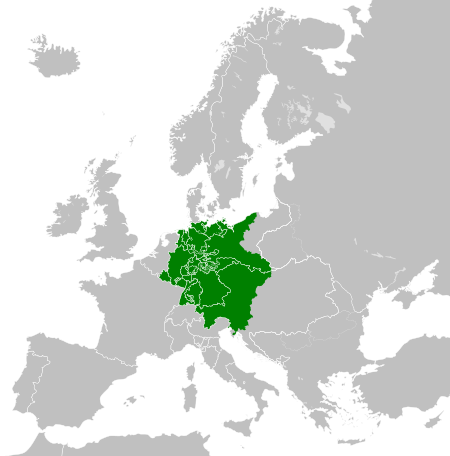
The German Confederation was formed in 1815, following the Napoleonic Wars, which had led to the dissolution of the Holy Roman Empire in 1806. The Congress of Vienna, attended by representatives from Austria, Prussia, Russia, and United Kingdom, established the Confederation as a loose association of German-speaking states. The Confederation's founding members included Bavaria, Württemberg, and Saxony, among others. The Confederation's purpose was to provide a framework for cooperation and collective defense among its member states, while also maintaining their sovereignty.
⚖️ Structure and Governance
The German Confederation had a unique structure, with a federal assembly, known as the Bundesversammlung, which consisted of representatives from each member state. The assembly was presided over by the representative of Austria, but this was largely a formality, as the Confederation had no head of state. The Confederation's decisions were made through a process of unanimous voting, which often led to gridlock and inefficiency. Despite these limitations, the Confederation played an important role in maintaining peace and stability in Central Europe, with the support of key members like Prussia and Austria.
🌍 International Relations
The German Confederation's international relations were complex and often tense, particularly with regards to France and Denmark. The Confederation's member states had varying levels of autonomy, with some, like Prussia, pursuing independent foreign policies. The Confederation also had to navigate the complex web of alliances and rivalries between European powers, including the Quadruple Alliance and the Concert of Europe. The Confederation's relationships with other European powers, such as Russia and United Kingdom, were also significant, with Otto von Bismarck playing a key role in shaping the Confederation's foreign policy.
🔥 Dissolution and Legacy
The German Confederation was eventually dissolved in 1866, following the Austro-Prussian War, which saw Prussia emerge victorious over Austria. The war marked the end of the Confederation and the beginning of a new era of German history, with Prussia dominating the newly formed North German Confederation. The legacy of the German Confederation can be seen in the modern-day Germany, with its federal system of government and strong regional identities. The Confederation's history is also closely tied to that of Europe, with key events like the Congress of Vienna and the Austro-Prussian War shaping the course of European history.
Key Facts
- Year
- 1815-1866
- Origin
- Central Europe
- Category
- history
- Type
- organization
Frequently Asked Questions
What was the purpose of the German Confederation?
The German Confederation was formed to provide a framework for cooperation and collective defense among its member states, while maintaining their sovereignty. The Confederation's purpose was also to replace the Holy Roman Empire, which had dissolved in 1806. Key members like Prussia and Austria played a significant role in shaping the Confederation's purpose and direction.
How did the German Confederation function?
The German Confederation had a federal assembly, known as the Bundesversammlung, which consisted of representatives from each member state. The assembly was presided over by the representative of Austria, but this was largely a formality, as the Confederation had no head of state. The Confederation's decisions were made through a process of unanimous voting, which often led to gridlock and inefficiency. The Confederation's structure and function were influenced by the Congress of Vienna and the Quadruple Alliance.
What led to the dissolution of the German Confederation?
The German Confederation was dissolved in 1866, following the Austro-Prussian War, which saw Prussia emerge victorious over Austria. The war marked the end of the Confederation and the beginning of a new era of German history, with Prussia dominating the newly formed North German Confederation. The dissolution of the Confederation was also influenced by the rise of Otto von Bismarck and the unification of Germany.
What was the legacy of the German Confederation?
The legacy of the German Confederation can be seen in the modern-day Germany, with its federal system of government and strong regional identities. The Confederation's history is also closely tied to that of Europe, with key events like the Congress of Vienna and the Austro-Prussian War shaping the course of European history. The Confederation's legacy continues to influence European politics and international relations, with European Union and NATO playing a significant role in modern European affairs.
How did the German Confederation relate to other European powers?
The German Confederation's relationships with other European powers, such as France and Denmark, were complex and often tense. The Confederation had to navigate the complex web of alliances and rivalries between European powers, including the Quadruple Alliance and the Concert of Europe. The Confederation's relationships with other European powers were influenced by the Congress of Vienna and the Austro-Prussian War. Key figures like Otto von Bismarck played a significant role in shaping the Confederation's foreign policy and relationships with other European powers.