
Contents
Overview
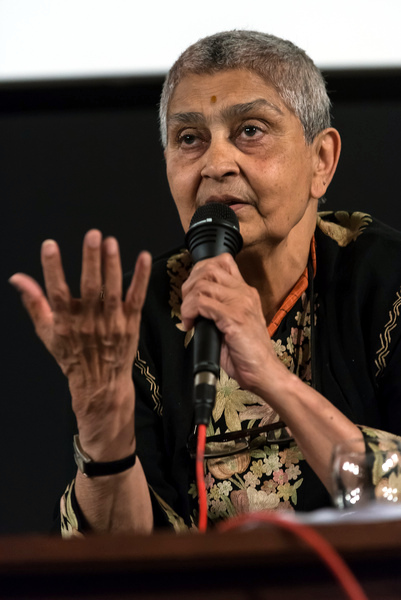
Gayatri Chakravorty Spivak was born on 24 February 1942 in Calcutta, India. She received her early education at the University of Calcutta and later moved to the United States to pursue her graduate studies at Cornell University. Spivak's academic career has been marked by her association with prominent institutions such as Columbia University, where she is currently a University Professor, and the Institute for Comparative Literature and Society, which she co-founded.
💡 Key Works & Ideas
Spivak's most influential work is arguably her essay 'Can the Subaltern Speak?', which challenges the dominant discourses of postcolonial theory and raises important questions about the representation of marginalized voices. Her translation of Jacques Derrida's De la grammatologie is also widely acclaimed, and she has written extensively on the works of Mahasweta Devi, a prominent Indian writer and activist. Spivak's work has been influenced by Karl Marx, Michel Foucault, and Frantz Fanon, among others.
🌎 Cultural Impact & Awards
Spivak's contributions to critical theory and education have been recognized through several awards, including the 2012 Kyoto Prize in Arts and Philosophy and the 2013 Padma Bhushan, the third highest civilian award given by the Government of India. Her work has also been acknowledged by institutions such as the American Academy of Arts and Sciences and the Modern Language Association. Spivak's influence extends beyond academia, with her ideas being applied in fields such as postcolonial studies, feminist theory, and cultural studies.
📢 Legacy & Influence
Spivak's legacy continues to inspire new generations of scholars and activists, who engage with her work in various contexts, from critical race theory to environmental humanities. Her influence can be seen in the work of scholars such as Homi K. Bhabha, Dipesh Chakrabarty, and Rosalind Kumar, among others. As a prominent public intellectual, Spivak remains committed to speaking truth to power and challenging dominant discourses, inspiring others to do the same.
Key Facts
- Year
- 1942
- Origin
- Calcutta, India
- Category
- philosophy
- Type
- person
Frequently Asked Questions
What is Gayatri Chakravorty Spivak's most influential work?
Spivak's most influential work is arguably her essay 'Can the Subaltern Speak?', which challenges the dominant discourses of postcolonial theory and raises important questions about the representation of marginalized voices. This essay has been widely acclaimed and has influenced scholars such as Homi K. Bhabha and Dipesh Chakrabarty.
What is the significance of Spivak's translation of Jacques Derrida's De la grammatologie?
Spivak's translation of De la grammatologie is significant because it introduced Derrida's work to a wider audience and helped to establish him as a major figure in poststructuralist thought. This translation has been influential in fields such as postcolonial studies and cultural studies.
How has Spivak's work been recognized and awarded?
Spivak's contributions to critical theory and education have been recognized through several awards, including the 2012 Kyoto Prize in Arts and Philosophy and the 2013 Padma Bhushan. Her work has also been acknowledged by institutions such as the American Academy of Arts and Sciences and the Modern Language Association.
What is the impact of Spivak's work on contemporary scholarship?
Spivak's work has had a significant impact on contemporary scholarship, particularly in fields such as postcolonial studies, feminist theory, and cultural studies. Her ideas have been applied in various contexts, from critical race theory to environmental humanities.
How does Spivak's work relate to other prominent scholars in the field?
Spivak's work is closely related to that of other prominent scholars in the field, such as Homi K. Bhabha, Dipesh Chakrabarty, and Rosalind Kumar. Her ideas have been influential in shaping the field of postcolonial studies and continue to inspire new generations of scholars and activists.