
Contents
Overview
Filtration technologies represent a diverse array of methods and devices designed to separate solid particles from liquids or gases. These processes are fundamental across countless industries, from ensuring the potability of drinking water and the purity of pharmaceuticals to enabling advanced manufacturing and environmental protection. The core principle involves passing a fluid through a porous medium that retains the unwanted contaminants while allowing the purified fluid to pass. Technologies range from simple mechanical sieving and depth filtration to sophisticated membrane processes, each tailored to specific separation requirements. Global demand for advanced filtration solutions is driven by increasing regulatory standards, growing populations, and the need for resource efficiency.
🎵 Origins & History
The concept of filtration is as old as civilization itself, with early humans likely using woven materials to strain water or separate solids from liquids. The formal scientific understanding began to crystallize in the 17th century with the development of early microscopes, which allowed for the observation of microscopic particles. The industrial revolution spurred significant advancements, leading to the development of filter presses by William Henry Perkin and others in the 19th century for large-scale applications in mining and chemical processing. The 20th century saw the rise of synthetic filter media and advanced membrane technologies, transforming fields like water treatment and medicine.
⚙️ How It Works
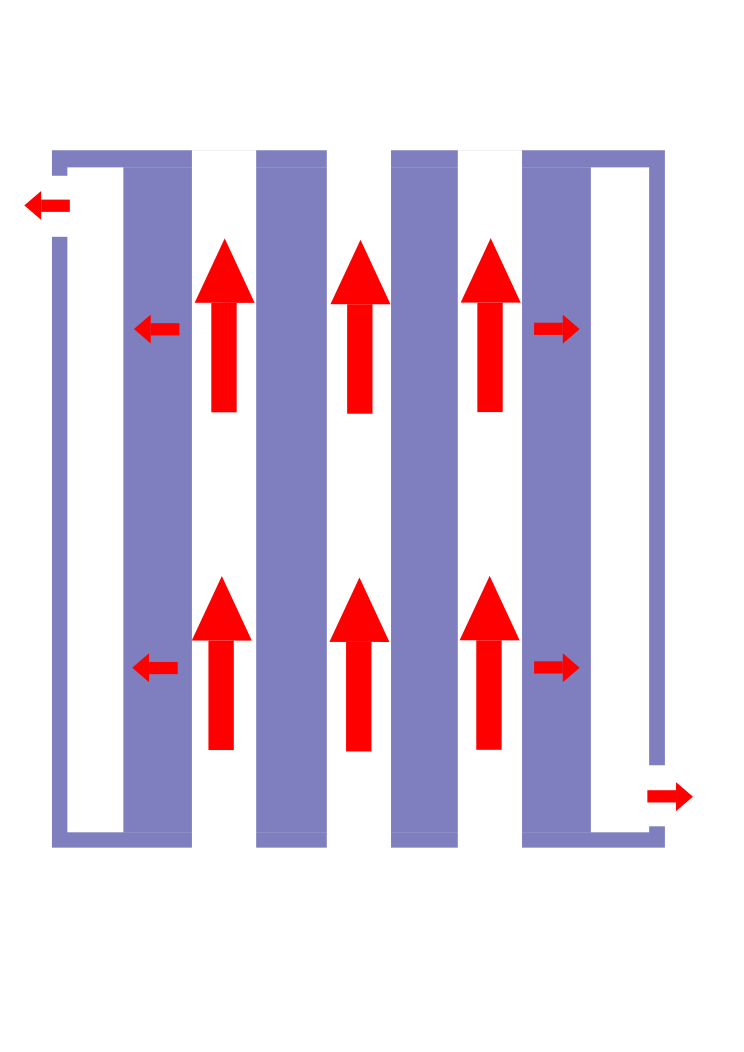
Filtration technologies operate on the principle of selective permeability. In mechanical filtration, fluids are forced through a porous medium, such as a cloth filter, sand bed, or sintered metal element, where particles larger than the pore size are physically retained. Depth filtration utilizes a thick, tortuous path within the filter medium, trapping particles throughout its depth. Membrane filtration, a more advanced category, employs semi-permeable membranes to separate molecules, ions, and even viruses based on size, charge, or chemical affinity. These processes are often driven by pressure gradients, as seen in cross-flow filtration systems which continuously sweep the membrane surface to prevent clogging.
📊 Key Facts & Numbers
The global filtration market is a colossal enterprise, with the water and wastewater filtration segment accounting for a significant share of annual activity. The pharmaceutical and medical filtration market is also substantial, driven by stringent purity requirements for drugs and sterile environments. Industrial filtration, encompassing air and liquid purification for manufacturing, remains a major segment of the industry. Advanced membrane filtration technologies, particularly reverse osmosis, are experiencing rapid growth as global demand for purified resources increases.
👥 Key People & Organizations
Pioneers in the 17th century laid the observational groundwork, while 19th-century engineers developed early industrial methods. Modern advancements are driven by research in materials science and chemical engineering. Various global corporations drive innovation by developing proprietary membrane and media technologies. International organizations set standards and promote best practices, influencing regulatory frameworks worldwide to ensure safety and efficiency in filtration applications.
🌍 Cultural Impact & Influence
Filtration technologies are deeply embedded in the fabric of modern life, often operating invisibly to maintain public health and industrial efficiency. Municipal filtration systems are essential for providing clean drinking water to populations. In medicine, filtration is used to maintain sterile environments and process fluids. The ability to purify air is a cornerstone of high-tech manufacturing, including the semiconductor industry. Furthermore, filtration plays a crucial role in environmental stewardship, enabling the capture of pollutants from industrial sources to mitigate ecological damage.
⚡ Current State & Latest Developments
The current landscape of filtration technologies is marked by a relentless pursuit of higher efficiency, greater selectivity, and enhanced sustainability. Smart filters that can self-clean or indicate their saturation level are emerging, promising reduced maintenance and operational costs. In the water sector, advancements in forward osmosis and electrodialysis are offering more energy-efficient desalination solutions. The integration of artificial intelligence (AI) and machine learning is also transforming filtration, enabling predictive maintenance and optimizing process parameters in real-time for large-scale industrial systems.
🤔 Controversies & Debates
One of the primary controversies surrounding filtration technologies revolves around the disposal of used filter media and membranes. Disposal of used filter media and membranes generates significant solid waste, contributing to landfill burden and potential environmental contamination, especially when dealing with hazardous materials. The energy consumption of high-pressure filtration processes, such as reverse osmosis desalination, also raises concerns about their carbon footprint. Furthermore, the effectiveness of certain consumer-grade filters in removing emerging contaminants like PFAS is a subject of ongoing research and debate.
🔮 Future Outlook & Predictions
The future of filtration technologies points towards increasingly intelligent, sustainable, and highly specialized solutions. We can expect to see a surge in the adoption of filters capable of molecular-level separation, potentially enabling highly efficient resource recovery and pollutant removal. The development of bio-integrated filters could offer novel ways to degrade specific contaminants. Energy efficiency will remain a key driver, with research focusing on passive filtration methods and hybrid systems that minimize external power requirements. The integration of IoT (Internet of Things) sensors and AI will lead to fully autonomous filtration systems that self-optimize and adapt to changing feed conditions.
💡 Practical Applications
Filtration technologies are indispensable across a vast spectrum of applications. In municipal water treatment, they ensure safe drinking water by removing pathogens and suspended solids, often using multi-stage processes involving sedimentation, coagulation, and activated carbon filtration. The pharmaceutical industry relies on filtration to produce injectable drugs and vaccines. In the automotive sector, oil and air filters are critical for engine longevity and performance. The food and beverage industry uses filtration for clarifying juices, filtering beer and wine, and purifying milk. In electronics manufacturing, ultra-pure water produced via filtration is essential for cleaning semiconductor wafers.
Key Facts
- Category
- technology
- Type
- topic