
Contents
Overview
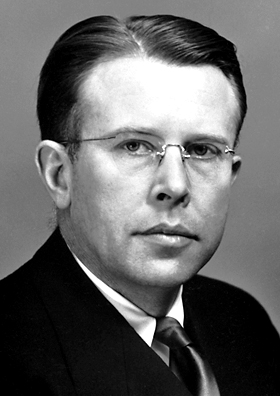
Ernest Orlando Lawrence (August 8, 1901 – August 27, 1958) was an American physicist. His groundbreaking invention of the cyclotron earned him the Nobel Prize in Physics in 1939. This revolutionary device, a circular particle accelerator, enabled physicists to smash atomic nuclei with unprecedented energy, unlocking new frontiers in nuclear physics and medicine. Lawrence's genius wasn't confined to theoretical breakthroughs; he was a master builder and organizer, founding not one, but two major national laboratories: the Lawrence Berkeley National Laboratory (LBNL) and the Lawrence Livermore National Laboratory (LLNL). His work on uranium isotope separation was critical to the Manhattan Project during World War II, demonstrating his capacity to translate fundamental science into world-altering applications. Lawrence's legacy is etched in the very fabric of modern physics and national security, forever associated with the powerful machines that bear his name.
🎵 Origins & History
Born in Canton, South Dakota, on August 8, 1901, Ernest Orlando Lawrence hailed from a family of educators. His early academic journey saw him attend St. Olaf College and Augustana Academy before pursuing higher education at the University of South Dakota and the University of Minnesota. It was at Yale University where he completed his PhD in physics, laying the groundwork for his future innovations. By 1928, Lawrence had joined the faculty at the University of California, Berkeley, rapidly ascending to full professor by 1930, becoming the youngest to hold the title. His formative years were steeped in the burgeoning field of nuclear physics, influenced by contemporaries like J. Robert Oppenheimer and the general scientific fervor of the interwar period.
⚙️ How It Works
The cyclotron, Lawrence's signature invention, operates on a deceptively simple principle that required immense engineering precision. It uses a strong magnetic field to bend charged particles, typically protons or ions, into a spiral path within two D-shaped electrodes called 'dees'. An alternating electric field between the dees accelerates the particles each time they cross the gap. As the particles gain energy, their spiral path lengthens, but their orbital period remains constant due to relativistic effects being managed by the magnetic field's strength and the particle's increasing velocity. This continuous acceleration allows particles to reach very high energies within a compact device, a stark contrast to linear accelerators of the era. The first successful cyclotron, built in 1930, was a modest affair but proved the concept's viability, paving the way for larger, more powerful machines.
📊 Key Facts & Numbers
Lawrence's impact is quantifiable: he was awarded the Nobel Prize in Physics in 1939, a prestigious honor recognizing his invention of the cyclotron. The first cyclotron he built in 1930 had a diameter of only 10 cm (4 inches) and cost approximately $25,000. By 1939, his team had constructed a 60-inch cyclotron capable of accelerating particles to 20 MeV (mega-electronvolts). During World War II, Lawrence's electromagnetic separation method for uranium isotopes at Oak Ridge was critical for the Manhattan Project, contributing to the development of the atomic bomb. The Lawrence Berkeley National Laboratory (LBNL), which he founded in 1931 as the Radiation Laboratory, has since hosted 11 Nobel laureates. The Lawrence Livermore National Laboratory (LLNL), co-founded by Lawrence in 1952, is another testament to his vision, employing over 6,000 people today.
👥 Key People & Organizations
Ernest Lawrence's professional life was deeply intertwined with several key institutions and individuals. His primary academic home was the University of California, Berkeley, where he mentored a generation of physicists. Key collaborators included his brother, John H. Lawrence, who pioneered medical applications of radioisotopes, and Donald Cook, who helped design early cyclotrons. J. Robert Oppenheimer, a colleague at Berkeley, later led the Los Alamos Laboratory during the Manhattan Project. The National Science Foundation and the Department of Energy have continued to fund research at the laboratories he founded, building upon his legacy. His wife, Mary K. Blumer, was the daughter of a Yale professor and a steadfast supporter of his demanding career.
🌍 Cultural Impact & Influence
The cyclotron's invention fundamentally altered the landscape of physics research, enabling the discovery of numerous new elements and isotopes. Beyond pure science, Lawrence's work had profound medical implications; the radioisotopes produced by cyclotrons became vital tools for cancer treatment and diagnostic imaging, a field championed by his brother, John. His role in the Manhattan Project highlights the dual-edged sword of scientific advancement, demonstrating how fundamental research can be rapidly weaponized. The establishment of LBNL and LLNL created enduring hubs for scientific innovation and national security, shaping the trajectory of American scientific policy and research infrastructure for decades. The very concept of a large, government-funded national laboratory owes much to Lawrence's pioneering model.
⚡ Current State & Latest Developments
The legacy of Ernest Lawrence continues to resonate in the ongoing advancements at the Lawrence Berkeley National Laboratory and Lawrence Livermore National Laboratory. These institutions remain at the forefront of scientific discovery, from exploring the fundamental forces of nature to developing advanced materials and energy solutions. The principles behind the cyclotron, though refined and augmented by modern technologies like synchrotrons and particle colliders such as the Large Hadron Collider, still underpin much of particle physics research. Furthermore, the medical applications of radioisotopes, pioneered by Lawrence and his brother, continue to expand, with new diagnostic and therapeutic agents being developed annually. The ongoing quest for fusion energy also owes a debt to the early accelerators that proved the feasibility of manipulating atomic nuclei.
🤔 Controversies & Debates
The most significant controversy surrounding Lawrence's work, particularly in hindsight, is his direct involvement in the Manhattan Project. While his contributions to isotope separation were scientifically brilliant and militarily crucial for the Allied victory, they also directly enabled the creation of the atomic bomb. This raises enduring ethical questions about the responsibility of scientists for the applications of their discoveries. Furthermore, the establishment of LLNL in 1952, alongside Los Alamos, was part of a broader Cold War push for nuclear weapons development, a mission that has drawn criticism from anti-nuclear proliferation advocates. The sheer scale and cost of the national laboratories he helped found have also periodically faced scrutiny regarding resource allocation and scientific priorities.
🔮 Future Outlook & Predictions
The future of particle acceleration, the field Lawrence so profoundly shaped, points towards even more powerful and sophisticated machines. Concepts like compact accelerators for medical isotope production are becoming increasingly viable, potentially decentralizing the creation of life-saving materials. Research into advanced accelerator technologies, such as plasma wakefield acceleration, promises to dramatically increase particle energies while reducing the size and cost of accelerators, potentially realizing Lawrence's dream of compact, high-energy machines. The national laboratories he founded will undoubtedly continue to be central to these efforts, pushing the boundaries of physics, materials science, and national security. The ongoing exploration of dark matter and dark energy, for instance, relies heavily on the advanced detection and acceleration capabilities that trace their lineage back to Lawrence's cyclotron.
💡 Practical Applications
The practical applications stemming from Lawrence's work are vast and life-altering. The cyclotron is indispensable for producing medical isotopes used in PET scans and cancer radiation therapy, saving countless lives annually. Beyond medicine, cyclotrons are used in materials science for ion implantation and surface modification, enhancing the durability and performance of various products. In industrial settings, they are employed for sterilization and food irradiation. The fundamental research enabled by Lawrence's accelerators has also led to a deeper understanding of nuclear structure, particle physics, and the very origins of the universe, influencing fields from cosmology to qu
Key Facts
- Category
- science
- Type
- topic