
Contents
- 📏 What is Young's Modulus, Really?
- ⚙️ How is it Measured and Calculated?
- 📈 The Vibe Score: Stiffness Rankings
- 🌉 Applications: Where Stiffness Matters Most
- 🤔 The Skeptic's Corner: Limitations and Nuances
- 💡 Historical Context: From Hooke to High-Tech
- 🚀 Future Trends: Beyond the Standard Modulus
- 🤝 Comparing Stiffness: Modulus vs. Other Metrics
- Frequently Asked Questions
- Related Topics
Overview
Young's modulus, often denoted by 'E', quantifies a material's stiffness – its resistance to elastic deformation under tensile or compressive stress. Born from Robert Hooke's 17th-century observations on springs, it's a fundamental property in engineering, dictating how structures will behave under load. A high Young's modulus signifies a rigid material, like diamond (over 1000 GPa), while a low one indicates flexibility, such as rubber (around 0.01-0.1 GPa). This value is crucial for everything from designing bridges and aircraft to understanding the biomechanics of bone. Its calculation, stress divided by strain within the elastic limit, provides a universal metric for material behavior, though its application can be complex for anisotropic or composite materials.
📏 What is Young's Modulus, Really?
Young's modulus, often denoted by 'E', is your go-to metric for understanding how much a material will deform under stress before it permanently changes shape. Think of it as the material's inherent resistance to stretching or squashing. A high Young's modulus means a material is stiff – it takes a lot of force to stretch it even a little. Conversely, a low modulus indicates a flexible material that deforms easily. This isn't just academic; it's the bedrock of designing everything from bridge cables to microelectronic components, directly impacting structural integrity and performance. Understanding this fundamental property is crucial for any engineer or designer.
⚙️ How is it Measured and Calculated?
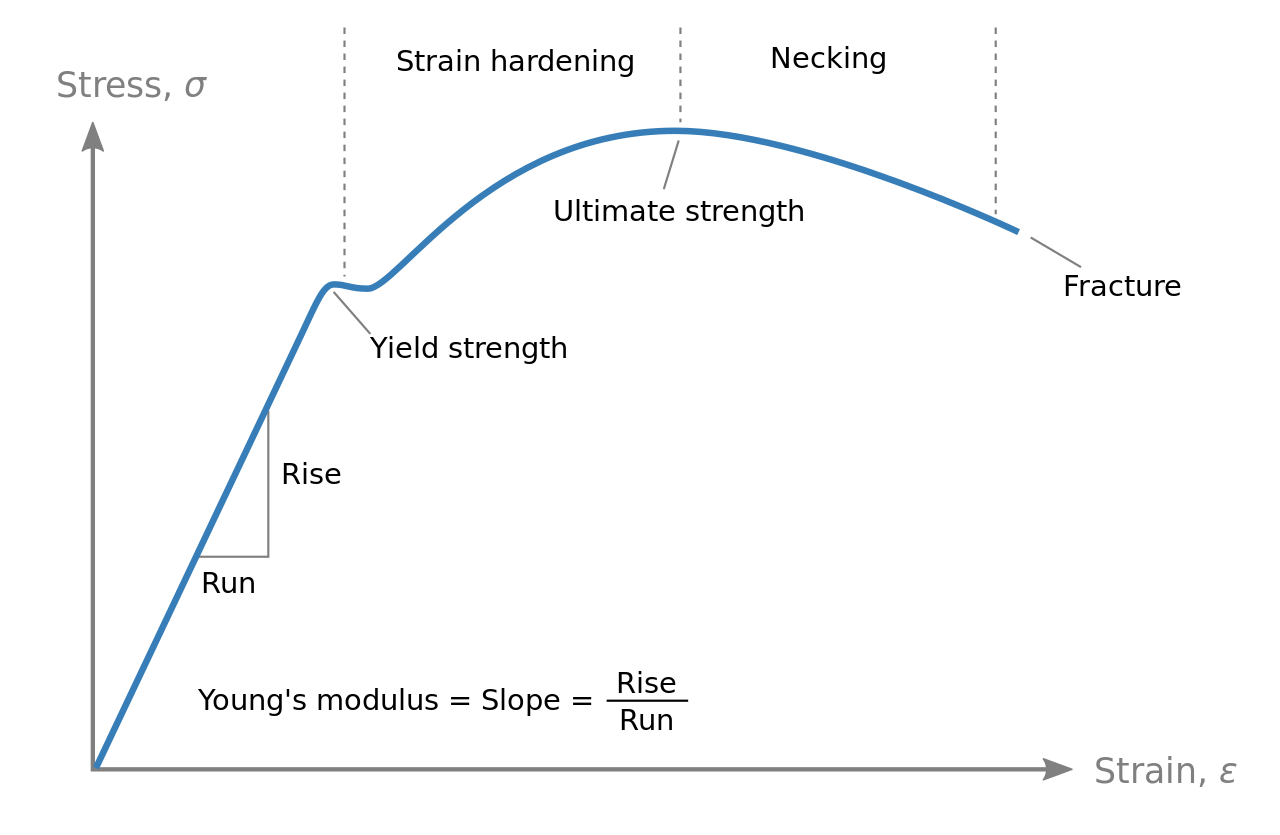
The calculation is deceptively simple: Young's modulus (E) equals stress (σ) divided by strain (ε) within the material's elastic limit. Stress is the force applied per unit area (P/A), and strain is the fractional change in length (ΔL/L). So, E = σ / ε = (P/A) / (ΔL/L). Practically, this is determined through tensile or compression tests using specialized machines like universal testing machines (UTMs). These tests meticulously measure the force applied and the resulting elongation or compression, allowing engineers to plot a stress-strain curve and extract the slope in the linear region – that slope is Young's modulus. It’s a direct quantitative measure of stiffness.
📈 The Vibe Score: Stiffness Rankings
On Vibepedia, we assign a 'Stiffness Vibe Score' (0-100) to materials based on their Young's modulus, contextualized by their typical applications and cultural impact. Diamond, with a modulus around 1000 GPa, scores a perfect 100, embodying ultimate stiffness. Steel hovers around 200 GPa, earning a solid 85, the workhorse of modern construction and machinery. Aluminum, at about 70 GPa, lands at a 60, prized for its lighter weight in aerospace and automotive sectors. Polymers like polyethylene, with moduli often below 1 GPa, score below 20, reflecting their inherent flexibility. This score helps you quickly gauge a material's 'stiffness vibe'.
🌉 Applications: Where Stiffness Matters Most
The applications of understanding Young's modulus are vast and critical. In civil engineering, it dictates the deflection of beams and the stability of columns in buildings and bridges, preventing catastrophic failures. In aerospace, it's vital for designing aircraft wings and fuselages that can withstand aerodynamic forces without excessive bending. For consumer products, it influences the feel and durability of everything from smartphone screens (Gorilla Glass has a high modulus) to athletic equipment like tennis rackets and bicycle frames, where a balance of stiffness and flexibility is key. Even in biomedical implants, the modulus must be carefully matched to surrounding bone to avoid stress shielding.
🤔 The Skeptic's Corner: Limitations and Nuances
The 'Skeptic's Corner' highlights that Young's modulus isn't the whole story. It's a linear elastic property, meaning it assumes stress is directly proportional to strain and that deformation is temporary. Many materials, especially polymers and composites, exhibit non-linear behavior or viscoelasticity, where deformation depends on time and temperature. Furthermore, the modulus can vary with temperature, strain rate, and even the direction of applied force in anisotropic materials like wood or carbon fiber composites. Relying solely on a single Young's modulus value can be misleading for complex engineering challenges, demanding a deeper dive into comprehensive testing.
💡 Historical Context: From Hooke to High-Tech
The concept traces its roots to Robert Hooke's 1660 law, 'Ut tensio, sic vis' (as the extension, so the force), but it was Thomas Young, in the early 19th century, who formally defined the elastic modulus in his work on the wave theory of light and mechanics. His meticulous experiments laid the groundwork for modern materials science. The development of precise testing equipment throughout the 20th century, from early tensile machines to today's sophisticated servo-hydraulic systems, has allowed for increasingly accurate measurements, driving innovation in fields from metallurgy to advanced composites.
🚀 Future Trends: Beyond the Standard Modulus
The future of stiffness measurement is moving beyond simple, isotropic Young's modulus. Researchers are developing methods to characterize the complex, multi-axial, and time-dependent mechanical responses of advanced materials. This includes understanding the directional properties of nanomaterials and metamaterials, where stiffness can be engineered at the atomic level. Computational modeling, using techniques like finite element analysis (FEA), is becoming increasingly sophisticated, allowing engineers to simulate material behavior under extreme conditions and predict performance with greater accuracy, pushing the boundaries of what's structurally possible.
🤝 Comparing Stiffness: Modulus vs. Other Metrics
While Young's modulus is the primary indicator of stiffness, it's not the only relevant mechanical property. Shear modulus (G) measures resistance to shearing or twisting, crucial for components subjected to torsional loads. Bulk modulus (K) quantifies resistance to uniform compression in all directions, important for fluids and solids under hydrostatic pressure. Poisson's ratio (ν) describes the tendency of a material to contract laterally when stretched longitudinally. For a complete picture, engineers often consider these properties in conjunction with tensile strength and impact resistance to select the optimal material for a given application.
Key Facts
- Year
- 1678
- Origin
- Robert Hooke's 'De Potentia Restitutiva, or Spring's Power'
- Category
- Materials Science & Engineering
- Type
- Concept/Property
Frequently Asked Questions
What's the difference between Young's Modulus and Strength?
Young's modulus measures stiffness – how much a material deforms elastically under load. Strength, on the other hand, measures the maximum stress a material can withstand before permanent deformation (yield strength) or fracture (ultimate tensile strength). A material can be stiff but brittle (high modulus, low strength) or flexible but strong (low modulus, high strength). Both are critical, but they describe different aspects of material behavior.
Is a higher Young's Modulus always better?
Not necessarily. A higher Young's modulus means greater stiffness, which is desirable for structural components that must resist bending or stretching, like bridge supports or aircraft wings. However, for applications requiring flexibility or shock absorption, such as springs, tires, or protective padding, a lower Young's modulus is preferred. The 'better' modulus depends entirely on the specific engineering requirements of the application.
How does temperature affect Young's Modulus?
Generally, Young's modulus decreases as temperature increases for most materials. Higher temperatures increase atomic vibrations, making it easier for atoms to move relative to each other, thus reducing the material's resistance to deformation. Conversely, at very low temperatures, materials often become stiffer, but they can also become more brittle. This temperature dependence is a critical factor in designing components for extreme environments.
Can Young's Modulus be negative?
In standard materials, Young's modulus is always positive. A negative modulus would imply that applying a tensile stress causes contraction, or a compressive stress causes expansion, which is physically counterintuitive for stable materials. However, theoretical concepts like 'exotic matter' or specific metamaterial designs might explore scenarios that appear to exhibit negative stiffness under certain conditions, but these are highly specialized and not representative of common engineering materials.
What units are used for Young's Modulus?
Young's modulus has units of pressure. The most common units are Pascals (Pa) or Megapascals (MPa) in the SI system. Gigapascals (GPa) are frequently used for stiffer materials like metals and ceramics. In the imperial system, units like pounds per square inch (psi) or kilopounds per square inch (ksi) are used. For example, steel typically has a Young's modulus of around 200 GPa or 29,000 ksi.