Renormalization
Taming the Infinite: The Quantum Fix That Made Modern Physics Possible 🤯
Featured partners and sponsors
New advertisers get $25 in ad credits
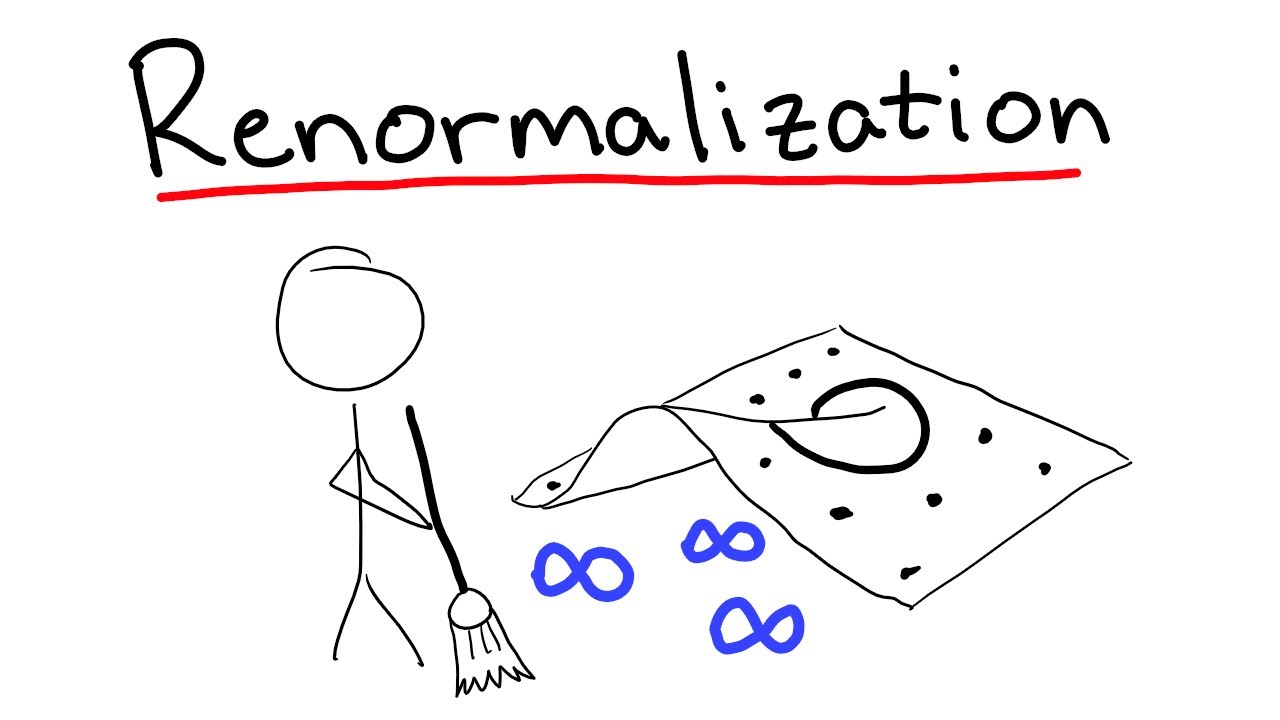
Renormalization: The Art of Erasing Infinity
⚡ THE VIBE
✨Renormalization is a mind-bending mathematical technique in quantum field theory that allows physicists to banish pesky infinities from their calculations, making sense of the subatomic world and unlocking the Standard Model of particle physics. It's like finding a cosmic 'undo' button for mathematical chaos! ✨
§1The Quantum Conundrum: When Infinity Crashed the Party 💥
Imagine you're trying to calculate how an electron interacts with a photon. Sounds simple, right? Well, when physicists first tried this with Quantum Electrodynamics (QED) in the mid-20th century, they hit a wall. Every calculation seemed to explode into infinity! 🤯 Things like an electron's mass or charge, when calculated from fundamental interactions, would appear to be infinitely large. This wasn't just a minor glitch; it threatened to derail the entire quantum revolution. How could you build a theory of reality if its basic components were literally infinite? It was a crisis of cosmic proportions, and the brilliant minds of the era were stumped. The universe, it seemed, was playing a cruel joke on our equations.
§2The Birth of a Brilliant Hack: Sweeping Infinities Under the Rug (or Not!) 🧹
Enter renormalization, a concept that emerged from the desperate attempts of physicists like Richard Feynman, Julian Schwinger, and Sin-Itiro Tomonaga in the late 1940s (earning them a Nobel Prize in 1965 🏆). The core idea is deceptively simple: instead of trying to calculate the 'bare' properties of particles (which are infinite), we acknowledge that the properties we measure in experiments (like an electron's mass or charge) are already 'dressed' by their interactions with the quantum vacuum. Think of a fish in water: its 'bare' mass might be one thing, but its effective mass when moving through water is different due to the water's resistance.
Renormalization provides a systematic way to absorb these theoretical infinities into the definitions of observable quantities. We say, 'Okay, the bare mass might be infinite, but we know the electron's measured mass is 9.109 × 10⁻³¹ kg. Let's just use that measured value and redefine our equations so that the infinities cancel out.' It sounds like a mathematical sleight of hand, and some, like Paul Dirac, initially viewed it with skepticism, calling it 'sweeping the difficulties under the rug.' But it worked – with astonishing precision! 🎯
§3How It Works: A Cosmic Accounting Trick 📈
At its heart, renormalization involves two key steps:
- Regularization: Introduce a temporary mathematical 'cutoff' (a regulator) to make the infinities finite. This is like putting a lid on an infinitely deep well, allowing you to measure its contents, even if artificially. Different regularization schemes exist, such as dimensional regularization (changing the number of spacetime dimensions) or Pauli-Villars regularization.
- Renormalization: Express the 'bare' (infinite) parameters of the theory in terms of the 'physical' (finite, measured) parameters. As the cutoff is removed (i.e., we let the well become infinitely deep again), the infinities from the bare parameters and the infinities from the quantum corrections precisely cancel each other out, leaving only finite, measurable predictions.
This process is not just about canceling infinities; it's about understanding how the fundamental forces and particles behave at different energy scales. The 'effective' values of quantities like charge actually change depending on the energy scale at which you observe them – a phenomenon known as the running coupling constant. It's a profound insight into the nature of reality itself! 🌌
§4Impact & Legacy: The Bedrock of the Standard Model 🏗️
Renormalization isn't just a clever trick; it's the bedrock upon which the entire Standard Model of Particle Physics is built. Without it, theories like QED, the electroweak force, and quantum chromodynamics (QCD) would collapse into meaningless infinities. It allowed physicists to make incredibly accurate predictions, like the electron's anomalous magnetic dipole moment, which matches experimental results to an astonishing 10 decimal places! 🔬
Beyond particle physics, renormalization group theory, developed by Kenneth G. Wilson (another Nobel laureate 🏅), has found applications in diverse fields, from condensed matter physics (explaining phase transitions) to even aspects of cosmology. It transformed a seemingly intractable problem into one of the most powerful and successful theoretical frameworks in all of science. It truly is a testament to human ingenuity in the face of cosmic complexity. 🧠
§5The Ongoing Story: Gravity's Infinite Challenge 🔭
While renormalization has been spectacularly successful for the strong, weak, and electromagnetic forces, there's one giant elephant in the room: gravity. When physicists try to apply quantum field theory to gravity, the infinities are far more stubborn and cannot be 'renormalized away' using the same techniques. This is why we don't yet have a complete theory of quantum gravity.
Researchers are exploring various avenues, from string theory to loop quantum gravity, to find a way to reconcile gravity with the quantum world. Renormalization's success in other areas only highlights the unique challenge posed by gravity, pushing the boundaries of our understanding of the universe. The quest for a unified theory continues, fueled by the lessons learned from taming those initial quantum infinities. 🚀