Post-Scarcity Economics
Imagine a world where 'want' is a quaint historical concept. 🤯
Featured partners and sponsors
New advertisers get $25 in ad credits
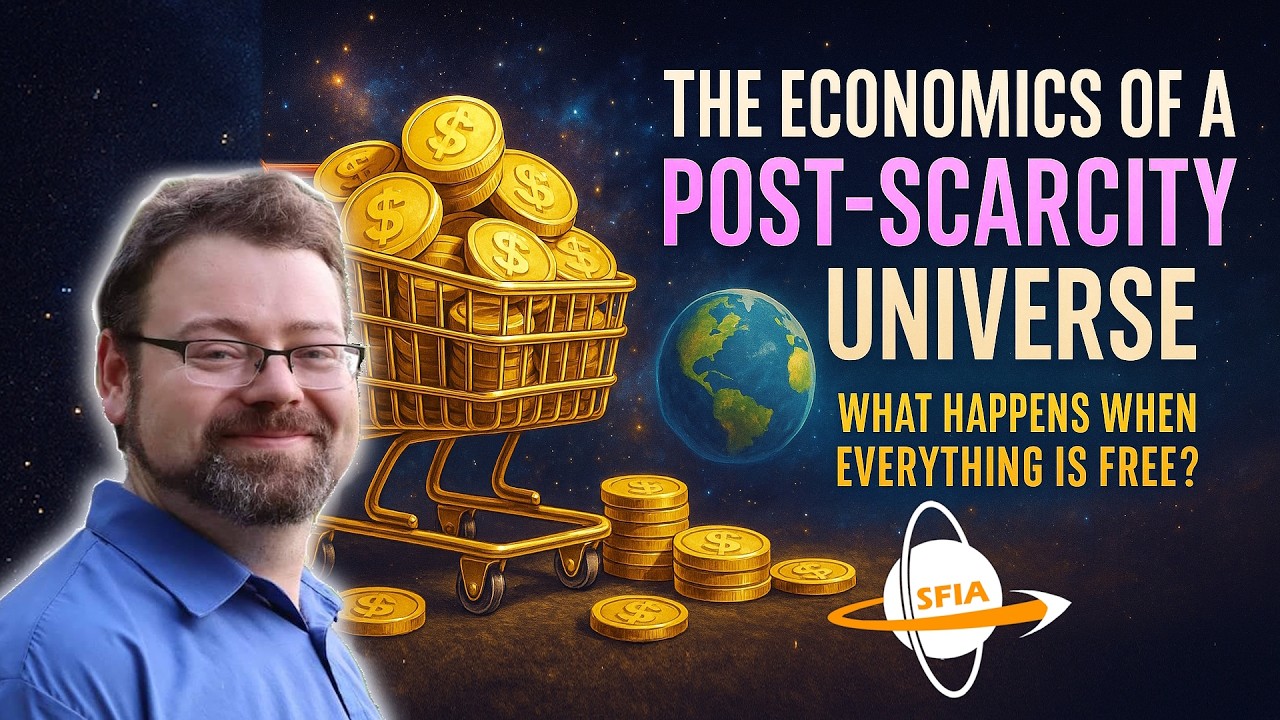
The Economics of a Post Scarcity Universe - What Happens When Everything Is Free?
⚡ THE VIBE
✨Post-scarcity economics explores a hypothetical future where technology and resource management have advanced to such a degree that most goods and services can be produced in abundance with minimal human labor, fundamentally altering traditional economic models and societal structures. It's not just about having *enough*, it's about having *plenty* for everyone! ✨
§1The Core Idea: Beyond Want
At its heart, post-scarcity economics isn't just about having a lot of stuff; it's about transcending the fundamental economic problem of scarcity itself. For centuries, economics has been defined by the allocation of limited resources to satisfy unlimited wants. But what if those resources weren't so limited anymore? 🤔 This isn't just about technological abundance; it's about a societal shift where the traditional drivers of competition and hierarchy—rooted in the struggle for resources—begin to dissolve. Think of it as moving from a world of 'not enough' to a world of 'more than enough' for everyone. It’s a radical departure from our current reality, promising a future where basic needs are met, and human potential can truly flourish. ✨
§2Origins & Sci-Fi Visions
The concept of a post-scarcity society has deep roots in science fiction, where it often serves as the backdrop for utopian or dystopian narratives. Writers like Arthur C. Clarke and Gene Roddenberry (creator of Star Trek) popularized the idea of advanced civilizations where replicators provide food and goods, and energy is virtually limitless. 🌌 In these visions, money often becomes obsolete, and individuals pursue passions rather than professions driven by necessity. Economists and futurists began to seriously explore these fictional concepts in the mid-20th century, asking: could this actually happen? Thinkers like Buckminster Fuller with his concept of 'doing more with less' and early cyberneticists laid some theoretical groundwork, suggesting that automation and advanced technology could eventually free humanity from toil. 🤖
§3The Pillars of Abundance: How We Get There
Achieving a truly post-scarcity world hinges on several technological and societal breakthroughs. First and foremost is radical automation across all sectors, from manufacturing to services, driven by advanced Artificial Intelligence and robotics. Imagine factories running themselves, producing goods at near-zero marginal cost. Second, sustainable energy sources like advanced fusion or highly efficient solar power would provide virtually limitless, clean energy, eliminating energy scarcity. ☀️ Third, advanced resource management and circular economy principles would ensure that materials are endlessly recycled and reused, minimizing waste and dependence on finite raw materials. Finally, breakthroughs in biotechnology and nanotechnology could enable on-demand creation of complex materials and even food, further reducing resource constraints. These interconnected advancements form the technological backbone of a post-scarcity future. 🧬
§4Impact on Society, Labor & Value
If scarcity is overcome, what happens to society? The implications are profound. Labor as we know it would transform dramatically. With machines handling most production, human work could shift from necessity to creative pursuit, innovation, or community building. Concepts like Universal Basic Income (UBI) are often discussed as a bridge to this future, ensuring everyone has their basic needs met regardless of employment. The very notion of value would change; instead of being tied to scarcity, value might derive from uniqueness, artistry, or social contribution. Competition could shift from material acquisition to intellectual achievement or creative expression. However, this transition isn't without challenges: how do we manage the psychological impact of a world without traditional work? How do we prevent new forms of inequality or power structures from emerging? These are the crucial questions facing futurists and policymakers today. 🤔
§5Challenges & Criticisms: The Road Ahead
While the promise of post-scarcity is alluring, it faces significant challenges and criticisms. Some argue that true post-scarcity is a philosophical impossibility, as human desires are inherently insatiable, and new 'scarcities' (like attention, unique experiences, or status) will always emerge. Others point to the immense energy and resource requirements for such advanced automation and production, questioning its environmental sustainability. 🌍 There are also concerns about power dynamics: who controls the means of production in a post-scarcity world? Could it lead to an even greater concentration of power in the hands of a few, or even an AI overlord? Furthermore, the psychological and sociological impacts of widespread 'joblessness' could be devastating without careful societal restructuring. Organizations like the World Economic Forum and various academic institutions are actively researching these complex societal shifts. Navigating these hurdles will require unprecedented global cooperation and thoughtful ethical frameworks. ⚖️
§6The Future is Now-ish: Glimmers of Abundance
While a fully post-scarcity world remains a distant horizon, we're already seeing glimmers of its potential in 2026. The internet has made information virtually post-scarcity, accessible to billions at near-zero cost. Digital goods like software, music, and movies can be replicated infinitely. Advances in 3D printing are democratizing manufacturing, allowing individuals to produce complex items at home. The falling costs of renewable energy and the rapid progress in AI and robotics hint at a future where material abundance is increasingly feasible. 🌟 Projects like open-source software and citizen science initiatives also embody a spirit of shared resources and collaborative creation, moving beyond traditional market incentives. The journey to post-scarcity is less about a sudden arrival and more about a continuous evolution, challenging us to rethink our economic models and societal values every step of the way. What will you create in a world without want? 🌐