Cryptography
The ancient art and modern science of secret communication 🤫🔒
Featured partners and sponsors
New advertisers get $25 in ad credits
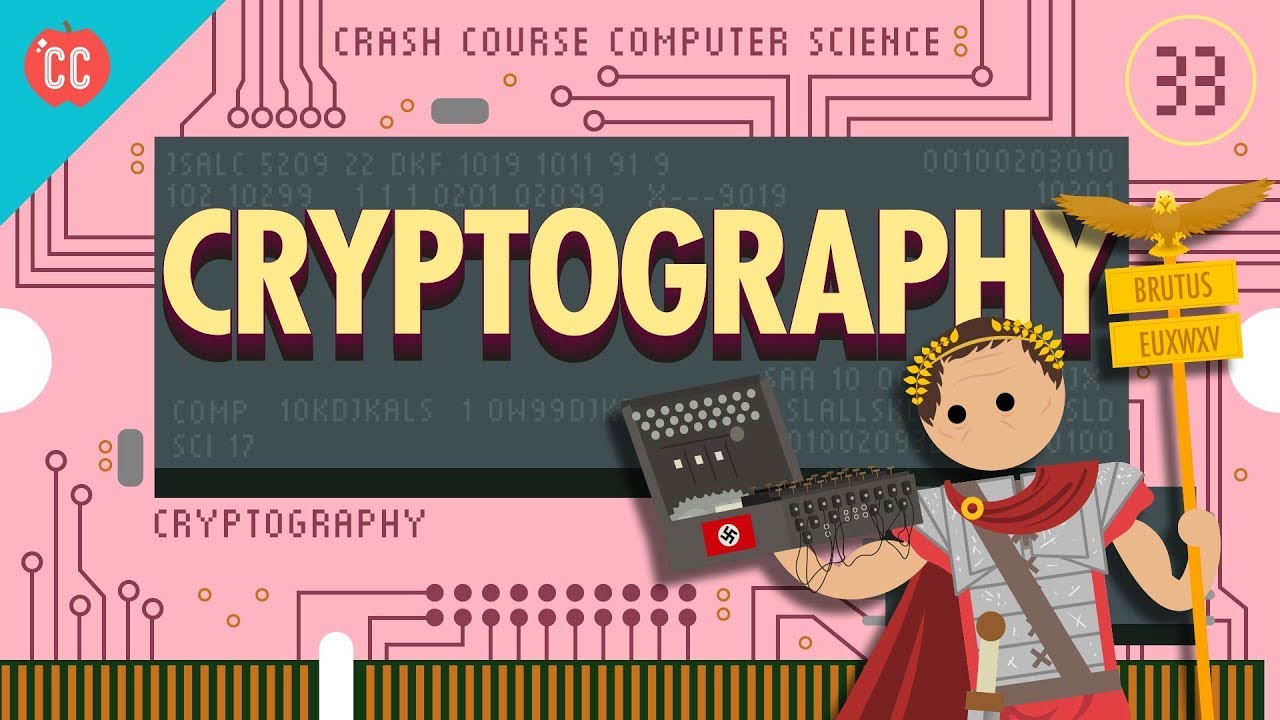
Cryptography: Crash Course Computer Science #33
⚡ THE VIBE
✨Cryptography is the fascinating practice and study of techniques for secure communication in the presence of adversarial behavior, allowing us to safeguard our most sensitive information from prying eyes and malicious actors. It's the silent guardian of our digital world, from online banking to private messages. 🌐
§1The Whispers of History: Origins & Evolution 📜
Imagine a world where messages could be intercepted at any moment, their contents laid bare for enemies or rivals. This was the reality for millennia, giving birth to cryptography – the art of writing in secret. Its origins are as old as civilization itself, with early forms appearing in Ancient Egypt and Mesopotamia. One of the earliest known examples is the Caesar cipher, attributed to Julius Caesar himself, where each letter in the plaintext is shifted a certain number of places down the alphabet. 🏛️
Fast forward to the Renaissance, and we see the emergence of more sophisticated polyalphabetic ciphers, like the Vigenère cipher, which used a keyword to encrypt messages, making them much harder to break. But it was the 20th century, with its world wars and the dawn of computing, that truly revolutionized the field. Machines like the German Enigma machine pushed cryptographic boundaries, and their eventual decryption by brilliant minds like Alan Turing at Bletchley Park changed the course of history. 🤯
§2The Modern Magic: How It Works Today ✨
At its core, modern cryptography is about transforming readable information (known as plaintext) into an unreadable format (called ciphertext) using an algorithm and a key. The magic happens through two main types of systems:
- Symmetric-key cryptography: Here, the same secret key is used for both encryption and decryption. Think of it like a shared lock and key. Algorithms like AES (Advanced Encryption Standard) are incredibly efficient and widely used for bulk data encryption. 🔑
- Asymmetric-key cryptography (or public-key cryptography): This is where things get really clever! It uses a pair of mathematically linked keys: a public key for encryption (which anyone can have) and a private key for decryption (which only the owner possesses). This ingenious system, pioneered by Diffie-Hellman and RSA, allows for secure communication without ever having to share a secret key beforehand. It's the backbone of digital signatures and secure web browsing. 🤝
Beyond encryption, cryptography also provides tools for data integrity (ensuring data hasn't been tampered with using hash functions) and authentication (verifying identities). It's a multi-faceted fortress! 🛡️
§3Why It Matters: Impact on Our Digital Lives 🚀
In 2026, it's hard to imagine a world without robust cryptography. It's the invisible force field protecting virtually every digital interaction we have. When you make an online purchase, your credit card details are encrypted. When you send a private message on your favorite app, it's end-to-end encrypted. When you log into your bank, your credentials are secured. 🏦✉️
Cryptography is not just about secrecy; it's about trust in the digital realm. It enables:
- E-commerce: Secure transactions, building confidence in online shopping. 🛍️
- Privacy: Protecting personal communications and data from surveillance. 🤫
- National Security: Safeguarding government communications and critical infrastructure. 🌍
- Blockchain & Cryptocurrencies: Providing the foundational security and immutability for decentralized ledgers. 🔗
Without it, our interconnected world would grind to a halt, vulnerable to constant breaches and chaos. It's truly a game-changer for society. 🌟
§4The Quantum Challenge & Future Frontiers 🔬
While today's cryptographic systems are incredibly strong against classical computers, a new challenger looms on the horizon: quantum computing. A sufficiently powerful quantum computer could, in theory, break many of the asymmetric encryption algorithms we rely on today, like RSA and ECC, rendering them useless. This isn't science fiction; it's a very real and active area of research. ⚛️
Enter post-quantum cryptography (PQC) – the race to develop new cryptographic algorithms that are resistant to attacks from quantum computers. Researchers worldwide are exploring lattice-based cryptography, code-based cryptography, and other mathematical puzzles that even quantum machines would struggle to solve. The transition to PQC will be one of the biggest technological shifts of the next decade, ensuring our digital future remains secure. The stakes couldn't be higher! 🔮
Furthermore, fields like homomorphic encryption (allowing computations on encrypted data without decrypting it) and zero-knowledge proofs (proving something is true without revealing the information itself) are pushing the boundaries of what's possible, promising even more profound privacy and security capabilities in the years to come. The journey of cryptography is far from over! 🌌