
Contents
Overview
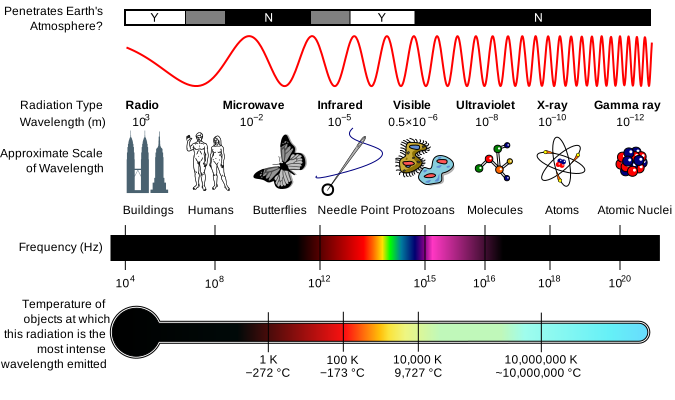
The electromagnetic spectrum is a fundamental concept in physics, encompassing the entire range of electromagnetic radiation. It is divided into several bands, including radio waves, microwaves, infrared, visible light, ultraviolet, X-rays, and gamma rays. Each band has unique properties, such as wavelength, frequency, and photon energy. For instance, radio waves, which have the lowest photon energy, are used in wireless communication systems, including cellular networks and Wi-Fi. In contrast, gamma rays, with the highest photon energy, are utilized in medical applications, such as cancer treatment and imaging technologies.
⚙️ Characteristics of Electromagnetic Waves
The characteristics of electromagnetic waves are crucial for understanding their interactions with matter. Radio waves, with wavelengths of thousands of kilometers, can pass through the atmosphere and most building materials, making them ideal for long-range communication. On the other hand, gamma rays, with wavelengths smaller than an atomic nucleus, are highly ionizing and can penetrate solid objects, but are also highly energetic and require specialized equipment to detect. Scientists like Niels Bohr and Ernest Rutherford have made significant contributions to our understanding of the electromagnetic spectrum and its applications. The development of technologies like magnetic resonance imaging (MRI) and positron emission tomography (PET) scans has relied heavily on the principles of the electromagnetic spectrum.
🌈 Applications of the Electromagnetic Spectrum
The electromagnetic spectrum has numerous practical applications, ranging from communication and navigation to medical imaging and treatment. Visible light, which is a small portion of the spectrum, is essential for human vision and is used in various technologies, including LCD displays and LED lights. Infrared radiation is used in thermal imaging, while ultraviolet radiation is used in disinfection and water purification. The electromagnetic spectrum is also crucial for understanding astronomical phenomena, such as the behavior of black holes and the properties of stars. Researchers at institutions like NASA and ESA rely on the electromagnetic spectrum to study the universe and make new discoveries.
🔍 Exploring the Spectrum with Technology
Advances in technology have enabled us to explore the electromagnetic spectrum in greater detail. The development of spectrographs and interferometers has allowed scientists to study the properties of electromagnetic waves and their interactions with matter. The Hubble Space Telescope and other space-based observatories have expanded our understanding of the universe, from the formation of galaxies to the properties of dark matter. As technology continues to evolve, our understanding of the electromagnetic spectrum and its applications will likely continue to grow, leading to new discoveries and innovations in fields like quantum computing and artificial intelligence.
Key Facts
- Year
- 1864
- Origin
- Scotland
- Category
- science
- Type
- concept
Frequently Asked Questions
What is the electromagnetic spectrum?
The electromagnetic spectrum is the complete range of electromagnetic radiation, from low-frequency radio waves to high-frequency gamma rays. It is a fundamental concept in physics, crucial for understanding various phenomena, including wireless communication, medical imaging, and astronomical observations. Researchers like Stephen Hawking and Neil deGrasse Tyson have contributed to our understanding of the electromagnetic spectrum.
What are the different bands of the electromagnetic spectrum?
The electromagnetic spectrum is divided into several bands, including radio waves, microwaves, infrared, visible light, ultraviolet, X-rays, and gamma rays. Each band has unique properties, such as wavelength, frequency, and photon energy. For example, radio waves are used in wireless communication, while gamma rays are used in medical applications. The development of technologies like GPS and Wi-Fi has relied heavily on the principles of the electromagnetic spectrum.
What are the practical applications of the electromagnetic spectrum?
The electromagnetic spectrum has numerous practical applications, ranging from communication and navigation to medical imaging and treatment. Visible light is essential for human vision, while infrared radiation is used in thermal imaging. The electromagnetic spectrum is also crucial for understanding astronomical phenomena, such as the behavior of black holes and the properties of stars. Researchers at institutions like NASA and ESA rely on the electromagnetic spectrum to study the universe and make new discoveries.
How has technology impacted our understanding of the electromagnetic spectrum?
Advances in technology have enabled us to explore the electromagnetic spectrum in greater detail. The development of spectrographs and interferometers has allowed scientists to study the properties of electromagnetic waves and their interactions with matter. The Hubble Space Telescope and other space-based observatories have expanded our understanding of the universe, from the formation of galaxies to the properties of dark matter. As technology continues to evolve, our understanding of the electromagnetic spectrum and its applications will likely continue to grow, leading to new discoveries and innovations in fields like quantum computing and artificial intelligence.
What are the current debates and challenges in the field of electromagnetic spectrum?
The current debates and challenges in the field of electromagnetic spectrum include the nature of light, the role of the electromagnetic spectrum in the universe, and the development of new technologies that can harness and manipulate electromagnetic radiation. Researchers are also exploring the potential applications of the electromagnetic spectrum in fields like medicine, astronomy, and materials science. The work of scientists like Richard Feynman and Murray Gell-Mann has contributed to our understanding of the electromagnetic spectrum and its role in the universe.