
Contents
Overview
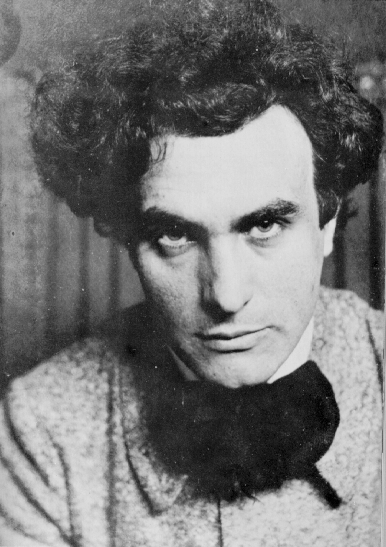
Edgard Varèse was born on December 22, 1883, in Paris, France, and began his musical journey at the Schola Cantorum in Paris, where he studied with Vincent d'Indy. He later moved to the United States, where he became a key figure in the American avant-garde music scene, collaborating with composers like Charles Ives and Henry Cowell. Varèse's music emphasizes timbre and rhythm, and he coined the term 'organized sound' to describe his unique aesthetic, which was influenced by the works of Arnold Schoenberg and Igor Stravinsky.
⚙️ How It Works
Varèse's conception of music reflected his vision of 'sound as living matter' and of 'musical space as open rather than bounded'. He conceived the elements of his music in terms of 'sound-masses', likening their organization to the natural phenomenon of crystallization. This approach was revolutionary for its time and paved the way for future experimentation in music, as seen in the works of Karlheinz Stockhausen and Luciano Berio. Varèse thought that 'to stubbornly conditioned ears, anything new in music has always been called noise', and he posed the question, 'what is music but organized noises?' This philosophy is reflected in his compositions, such as 'Arcana' and 'Déserts', which feature unconventional sounds and instrumentation, including the use of Theremin and Ondes Martenot.
🌍 Cultural Impact
Despite his complete surviving works only lasting about three hours, Varèse has been recognized as an influence by several major composers of the late 20th century. His music has been performed by renowned ensembles like the New York Philharmonic and the BBC Symphony Orchestra. Varèse's legacy extends beyond the classical music world, with his ideas about sound and space influencing artists like John Zorn and Laurie Anderson. His work has also been featured in various films and documentaries, including those by Stanley Kubrick and Martin Scorsese.
🔮 Legacy & Future
Today, Varèse's music remains a vital part of the avant-garde canon, with his compositions continuing to inspire new generations of musicians and composers. The Edgard Varèse Archives at the Library of Congress provide a valuable resource for scholars and researchers, offering insights into Varèse's creative process and artistic vision. As the music world continues to evolve, Varèse's innovative spirit and emphasis on experimentation remain a powerful influence, as seen in the works of contemporary composers like Steve Reich and Philip Glass.
Key Facts
- Year
- 1883-1965
- Origin
- Paris, France
- Category
- culture
- Type
- person
Frequently Asked Questions
What is organized sound?
Organized sound refers to the use of unconventional sounds and instrumentation in music, as coined by Edgard Varèse. This approach emphasizes timbre and rhythm, and seeks to create a new kind of musical experience. Varèse's music, such as 'Arcana' and 'Déserts', features unconventional sounds and instrumentation, including the use of Theremin and Ondes Martenot.
Who was influenced by Varèse's music?
Several major composers of the late 20th century were influenced by Varèse's music, including John Cage, Pierre Boulez, and Karlheinz Stockhausen. Varèse's emphasis on timbre and rhythm, as well as his use of unconventional sounds and instrumentation, paved the way for future experimentation in music.
What is the significance of Varèse's music?
Varèse's music is significant because it challenged traditional notions of music and sound. His emphasis on timbre and rhythm, as well as his use of unconventional sounds and instrumentation, expanded the possibilities of music and paved the way for future experimentation. Varèse's music has been performed by renowned ensembles like the New York Philharmonic and the BBC Symphony Orchestra, and has influenced a wide range of artists, from Laurie Anderson to Stanley Kubrick.
What is the legacy of Varèse's music?
Varèse's legacy is one of innovation and experimentation. His music continues to inspire new generations of musicians and composers, and his emphasis on timbre and rhythm remains a powerful influence on modern music. The Edgard Varèse Archives at the Library of Congress provide a valuable resource for scholars and researchers, offering insights into Varèse's creative process and artistic vision.
How does Varèse's music relate to other art forms?
Varèse's music has been featured in various films and documentaries, including those by Stanley Kubrick and Martin Scorsese. His music has also influenced artists like John Zorn and Laurie Anderson, who have incorporated elements of Varèse's style into their own work. Varèse's emphasis on experimentation and innovation has made his music a vital part of the avant-garde canon, and his influence can be heard in a wide range of musical genres, from classical to rock to electronic music.