
Contents
Overview
The story of E Ink began in 1997 when MIT undergraduates JD Albert and Barrett Comiskey, along with MIT Media Lab professor Joseph Jacobson, Jerome Rubin, and Russ Wilcox, co-founded the E Ink Corporation. Their vision was to create a display technology that could mimic the appearance of ink on paper, while also being flexible, low-power, and highly readable. This vision was realized with the development of E Ink, a brand of electronic paper (e-paper) display technology that has since been used in a wide range of mobile devices, including Amazon Kindle e-readers, Sony Reader devices, and Barnes & Noble Nook tablets.
⚙️ How It Works
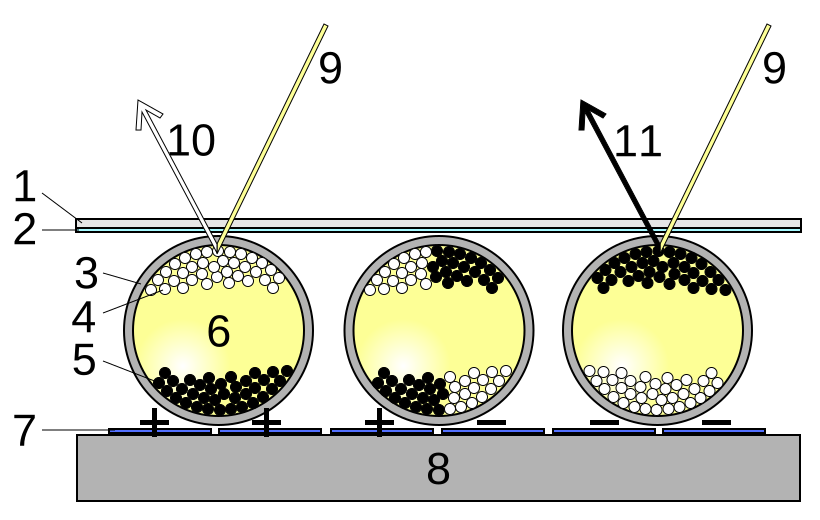
So, how does E Ink work? The technology uses microcapsules filled with positively charged white particles and negatively charged black particles. When an electric field is applied, the particles move to the top or bottom of the microcapsule, creating the appearance of text or images on the screen. This process is similar to the way that Epson printers use ink to print on paper, but with E Ink, the ink is replaced by electronic particles. The result is a display that is not only highly readable but also extremely low-power, making it ideal for use in mobile devices such as Apple Watch smartwatches and Samsung Galaxy mobile phones.
🌍 Cultural Impact
The cultural impact of E Ink cannot be overstated. The technology has revolutionized the way we consume digital content, making it possible to read books, newspapers, and magazines on the go without the need for a backlight. This has been particularly beneficial for people who enjoy reading, as it has made it possible to carry entire libraries of books with them wherever they go. E Ink has also been used in a wide range of other applications, including digital signage, electronic shelf labels, and architecture panels. Companies such as IBM and Google have also explored the use of E Ink in their products and services.
🔮 Legacy & Future
As we look to the future, it is clear that E Ink will continue to play a major role in the development of digital display technology. With its low power consumption, high readability, and flexibility, E Ink is an ideal technology for use in a wide range of applications, from mobile devices to digital signage. As companies such as Amazon and Microsoft continue to innovate and develop new products and services, it is likely that we will see even more exciting applications of E Ink in the years to come. Whether it is used in e-readers, smartwatches, or other mobile devices, E Ink is sure to remain a leading technology in the digital display industry.
Key Facts
- Year
- 1997
- Origin
- Cambridge, Massachusetts
- Category
- technology
- Type
- technology
Frequently Asked Questions
What is E Ink?
E Ink is a brand of electronic paper display technology that is used in a wide range of mobile devices, including e-readers, smartwatches, and electronic shelf labels. It was developed by the E Ink Corporation, which was founded in 1997 by JD Albert, Barrett Comiskey, Joseph Jacobson, Jerome Rubin, and Russ Wilcox.
How does E Ink work?
E Ink uses microcapsules filled with positively charged white particles and negatively charged black particles. When an electric field is applied, the particles move to the top or bottom of the microcapsule, creating the appearance of text or images on the screen. This process is similar to the way that Epson printers use ink to print on paper, but with E Ink, the ink is replaced by electronic particles.
What are the benefits of E Ink?
The benefits of E Ink include low power consumption, high readability, and flexibility. It is also highly readable in bright light, making it ideal for use in mobile devices such as Apple Watch smartwatches and Samsung Galaxy mobile phones.
What are some examples of E Ink in use?
E Ink is used in a wide range of applications, including Amazon Kindle e-readers, Sony Reader devices, and Barnes & Noble Nook tablets. It is also used in digital signage, electronic shelf labels, and architecture panels.