
Contents
Overview
The roots of drug discovery stretch back to ancient civilizations, where empirical observation led to the use of plants and minerals for healing. Traditional Chinese medicine, for instance, documented thousands of herbal remedies centuries before modern pharmacology. The 19th century saw the dawn of scientific drug discovery with the isolation of active compounds like morphine. A pivotal moment arrived with the accidental discovery of penicillin. The mid-20th century brought the rise of synthetic chemistry and the systematic screening of chemical libraries, exemplified by the development of thalidomide (though infamously later withdrawn due to severe side effects) and numerous other synthetic drugs. The mapping of the human genome revolutionized the field, enabling target-based drug discovery and a more rational approach to identifying disease mechanisms.
⚙️ How It Works
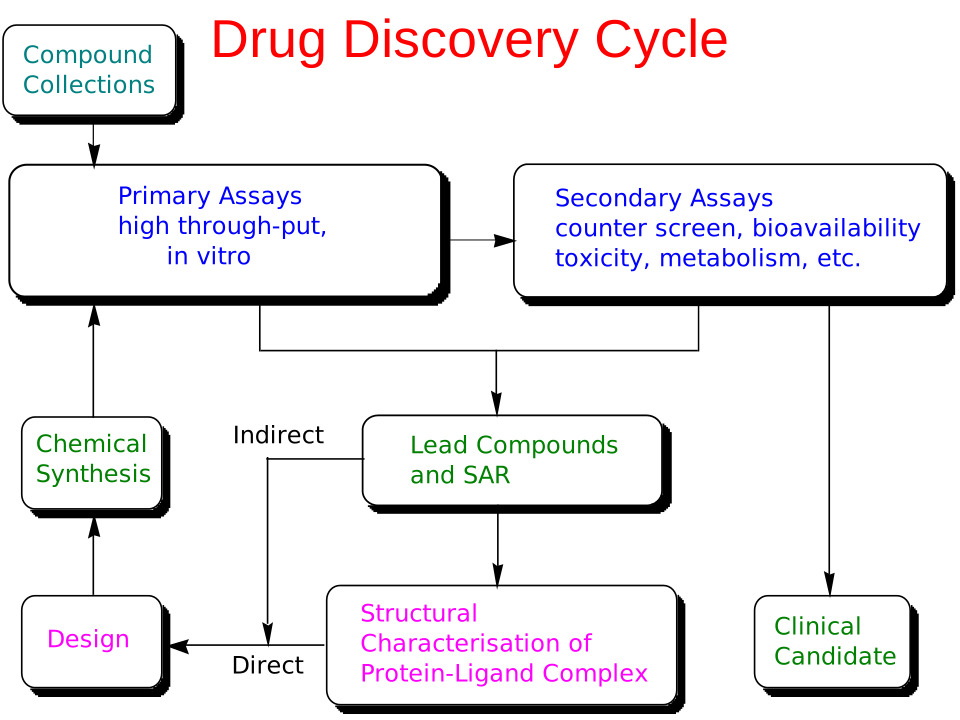
Modern drug discovery is a complex, iterative process typically beginning with target identification, where a specific molecule or pathway implicated in a disease is pinpointed. This is followed by hit identification, often through high-throughput screening (HTS) of vast chemical libraries, sometimes containing millions of compounds, against the identified target. Promising "hits" are then optimized through medicinal chemistry to improve potency, selectivity, and pharmacokinetic properties, becoming "leads." These lead compounds undergo extensive preclinical testing in cell cultures and animal models to assess efficacy and safety, including toxicology studies. Promising candidates then advance to clinical trials in humans, progressing through three phases to demonstrate safety and effectiveness before regulatory review by agencies like the U.S. Food and Drug Administration or the European Medicines Agency. The entire cycle is managed by sophisticated project management and often involves collaborations between academic institutions, biotech startups, and large pharmaceutical corporations like Pfizer and Roche.
📊 Key Facts & Numbers
The financial stakes in drug discovery are astronomical. The success rate is notoriously low. The global pharmaceutical market was valued at over $1.5 trillion in 2023 and is projected to grow significantly. Despite the investment, a significant percentage of drug development projects fail during clinical trials, often due to lack of efficacy or unexpected toxicity. The number of new molecular entities (NMEs) approved by the FDA has fluctuated, with around 40-50 NMEs typically approved annually in recent years, highlighting the bottleneck in the discovery pipeline.
👥 Key People & Organizations
Pioneering figures like Paul Ehrlich, often called the father of chemotherapy, laid foundational principles with his "magic bullet" concept in the early 20th century. Gertrude B. Elion and George H. Hitchings revolutionized drug development with their rational approach to drug design, earning a Nobel Prize for their work on cancer and antiviral drugs. Companies like Merck and Johnson & Johnson have long been giants in the pharmaceutical industry, with extensive R&D divisions. More recently, the rise of biotechnology firms such as Genentech (now part of Roche) and Amgen has introduced novel therapeutic modalities like monoclonal antibodies and gene therapies. Academic research institutions, including Harvard University and the Max Planck Society, remain crucial hubs for fundamental research that often seeds new drug discovery programs.
🌍 Cultural Impact & Influence
The impact of drug discovery on global health is immeasurable, dramatically increasing life expectancy. Breakthroughs in antibiotics, vaccines, and treatments for chronic conditions such as diabetes and heart disease have transformed societies. The development of antiretroviral therapy turned HIV/AIDS from a death sentence into a manageable chronic condition. Conversely, the high cost of newly discovered drugs, particularly in areas like oncology and rare diseases, raises significant ethical and access concerns, fueling debates about pharmaceutical pricing and intellectual property. The very definition of "disease" can also be influenced by drug discovery, as new treatments can lead to the reclassification or earlier diagnosis of conditions.
⚡ Current State & Latest Developments
The current landscape of drug discovery is heavily influenced by advancements in artificial intelligence and machine learning, which are being applied to accelerate target identification, predict compound efficacy, and optimize clinical trial design. CRISPR gene editing technology is opening new avenues for developing gene therapies and understanding disease mechanisms at an unprecedented level. The focus is increasingly shifting towards personalized medicine, tailoring treatments to an individual's genetic makeup, as seen with targeted cancer therapies like imatinib. The COVID-19 pandemic spurred rapid development of vaccines and antivirals, demonstrating the potential for accelerated timelines under urgent circumstances, a model some hope can be applied more broadly. The rise of biologics, including monoclonal antibodies and cell therapies, represents a significant departure from traditional small-molecule drugs.
🤔 Controversies & Debates
One of the most persistent controversies revolves around the exorbitant cost of new drugs and the pricing strategies of pharmaceutical companies, leading to debates about affordability and access, particularly in developing nations. The lengthy patent protection periods granted to drug developers are also contentious, balancing the need for recouping R&D investment against the public good of accessible medicines. Ethical considerations surrounding clinical trials, including patient consent, data integrity, and the use of placebos, are ongoing concerns. Furthermore, the phenomenon of "evergreening," where companies make minor modifications to existing drugs to extend patent life, faces criticism for stifling genuine innovation. The potential for unintended consequences from novel therapies, such as off-target effects or long-term resistance, remains a significant ethical and scientific challenge.
🔮 Future Outlook & Predictions
The future of drug discovery is poised for significant transformation, driven by AI and machine learning, which are expected to drastically reduce timelines and failure rates. The integration of real-world evidence (RWE) and advanced computational modeling will enable more precise prediction of drug behavior and patient response. Personalized medicine will become more mainstream, with treatments designed for specific genetic profiles and even individual patients. The exploration of novel therapeutic modalities, including RNA-based therapies, microbiome interventions, and advanced nanomedicine delivery systems, will continue to expand the therapeutic arsenal. There's also a growing emphasis on preventative medicine and early intervention, potentially shifting the focus from treating established diseases to preventing their onset, a paradigm shift that could redefine the role of drug discovery.
💡 Practical Applications
Drug discovery's practical applications are vast, forming the bedrock of modern medicine. Its most direct application is the development of pharmaceuticals for treating a myriad of diseases, from infectious agents like bacteria and viruses to chronic conditions like Alzheimer's and autoimmune disorders. Beyond human health, drug discovery principles are applied in veterinary medicine to develop treatments for animals. The techniques and technologies developed, such as [[high-throughput_screeni
Key Facts
- Category
- science
- Type
- topic