
Contents
Overview
The conceptual seeds of DNA barcoding were sown in the late 20th century with advancements in DNA sequencing technology and the growing need for robust biodiversity assessment. The formalization and popularization of the technique are largely credited to Paul Hebert and his colleagues at the University of Guelph in the early 2000s. Hebert, a Canadian evolutionary biologist, proposed using a standardized gene region, specifically a fragment of the mitochondrial cytochrome c oxidase subunit I (COI) gene, as a universal barcode for animals. This proposal, published in a landmark 2003 paper in Proceedings of the Royal Society B, ignited a global movement to build comprehensive DNA barcode reference libraries. Precursors to this standardized approach included earlier uses of DNA markers for species identification, such as ribosomal RNA genes, but DNA barcoding offered a more accessible and universally applicable framework. The initiative quickly gained traction, leading to the establishment of the International Barcode of Life (iBOL) project, a massive collaborative effort to barcode all multicellular life on Earth.
⚙️ How It Works
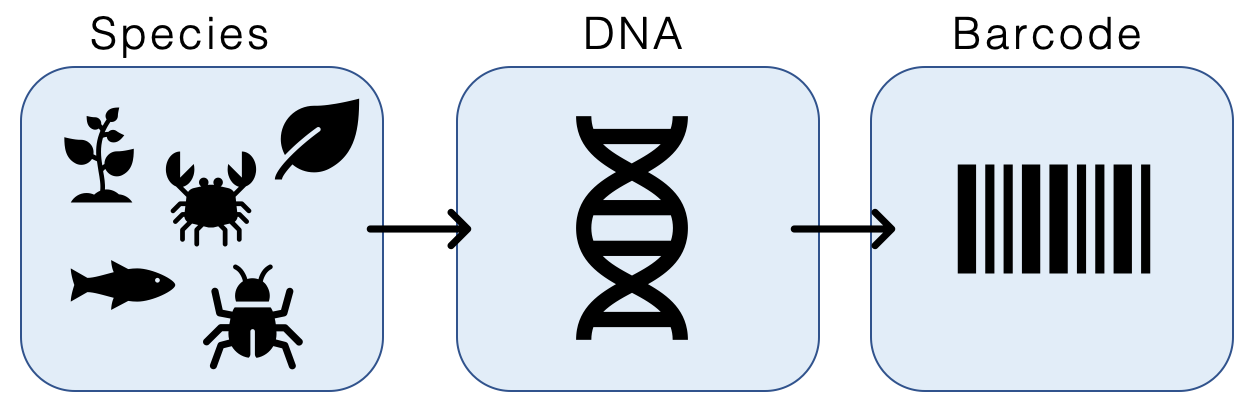
At its core, DNA barcoding relies on amplifying and sequencing a specific, short DNA region from an unknown specimen. For animals, this typically involves the mitochondrial COI gene, chosen for its relatively high mutation rate and conserved flanking regions that allow for universal primer design. The process begins with DNA extraction from tissue samples, followed by polymerase chain reaction (PCR) to amplify the target gene fragment. The amplified DNA is then sequenced, yielding a string of genetic code. This sequence is subsequently compared against a curated database, such as the BOLD Systems database, which houses millions of reference barcodes. Sophisticated algorithms match the query sequence to the closest known species, providing a high-confidence identification. For plants, different gene regions like rbcL and matK are often employed due to differing evolutionary rates and mitochondrial genome structures.
📊 Key Facts & Numbers
The scale of DNA barcoding is staggering. The iBOL project aims to barcode at least 500,000 species, and its database, BOLD Systems, already contains over 10 million DNA barcode records representing more than 100,000 species. Globally, over 1,500 research institutions and over 3,000 scientists have contributed to DNA barcoding efforts. In a single year, researchers might process hundreds of thousands of samples, leading to the discovery of dozens of new species. For instance, the project has already identified over 5,000 new species, with estimates suggesting that up to 80% of animal species remain undiscovered. The cost per barcode has decreased dramatically, from hundreds of dollars in the early 2000s to under $10 today, making large-scale biodiversity surveys economically feasible.
👥 Key People & Organizations
Paul Hebert, the evolutionary biologist at the University of Guelph, is widely recognized as the architect of modern DNA barcoding. His 2003 publication laid the foundation for the field. Key organizations driving the global effort include the iBOL, which coordinates research and data sharing worldwide. BOLD Systems serves as the central repository for DNA barcode data, managed by the Biodiversity Institute of Ontario. Numerous national and regional barcoding initiatives, such as BOLD Canada and the European Network for DNA Barcoding (eu-BOL), also play crucial roles. Researchers like David Schindel, former executive director of iBOL, and institutions like the Smithsonian Institution have been instrumental in advocating for and implementing barcoding projects across diverse taxa and geographic regions.
🌍 Cultural Impact & Influence
DNA barcoding has profoundly reshaped how we perceive and catalog biodiversity. It has democratized species identification, moving it beyond the exclusive domain of taxonomic specialists to a more accessible tool for a broader scientific community and even citizen scientists. This has led to a surge in species discovery, particularly among insects and marine invertebrates, challenging existing taxonomic boundaries and revealing the hidden diversity of life. The technique’s application in areas like food authenticity testing, for example, has raised consumer awareness about mislabeling and adulteration, influencing regulatory practices and market transparency. Furthermore, DNA barcoding has become a critical component in conservation biology, enabling rapid assessment of endangered species and the monitoring of illegal wildlife trade, as seen in efforts to combat poaching of pangolins and the trade in shark fins.
⚡ Current State & Latest Developments
The field of DNA barcoding is continuously evolving with technological advancements. Next-generation sequencing (NGS) technologies are now being integrated, allowing for the simultaneous barcoding of thousands of samples from complex mixtures, a technique known as metabarcoding. This is revolutionizing environmental monitoring, enabling researchers to assess biodiversity in soil, water, and gut contents without needing to isolate individual organisms. Efforts are also underway to expand barcoding to viruses and fungi, which present unique challenges due to their genetic diversity and replication mechanisms. The development of portable, real-time sequencing devices, such as those from Oxford Nanopore Technologies, promises to bring DNA barcoding capabilities directly into the field, accelerating species identification and response in remote locations or during rapid biodiversity surveys. The ongoing expansion of reference libraries, particularly in understudied regions like the tropics, remains a key focus.
🤔 Controversies & Debates
Despite its widespread adoption, DNA barcoding is not without its controversies. A primary debate centers on the reliability of COI as a universal barcode for all animals, as some species exhibit genetic divergence within the barcode region that can lead to over-splitting species (the 'species-delimitation problem'). Conversely, instances of incomplete lineage sorting or hybridization can result in different species sharing identical or near-identical barcodes, leading to under-splitting. Skeptics argue that DNA barcoding should not replace traditional morphological taxonomy but rather complement it, as morphology provides crucial ecological and evolutionary context. Ethical considerations also arise regarding data ownership and access, particularly for genetic resources from developing nations. The potential for misuse in bioprospecting without equitable benefit-sharing remains a concern, as highlighted by debates surrounding the Convention on Biological Diversity.
🔮 Future Outlook & Predictions
The future of DNA barcoding points towards greater integration with other 'omics' technologies and artificial intelligence. Machine learning algorithms are being developed to improve species delimitation from barcode data, potentially resolving some of the current controversies. The expansion of reference libraries will continue, with a focus on filling gaps in under-sampled regions and taxa, potentially leading to the discovery of millions more species. The application of DNA barcoding in forensic science is expected to grow, aiding in the identification of crime scene evidence and the tracking of illicit goods. Furthermore, the development of 'DNA e-DNA' (environmental DNA) analysis, which uses DNA shed by organisms into their environment, combined with barcoding, will offer unprecedented insights into ecosystem health and species distribution without direct observation. The ultimate goal is a comprehensive, globally accessible DNA barcode database that underpins all biological research and conservation efforts.
💡 Practical Applications
DNA barcoding has a vast array of practical applications across numerous sectors. In conservation, it aids in identifying endangered species, monitoring illegal wildlife trade (e.g., detecting ivory or rhino horn products), and assessing the impact of invasive species. The fo
Key Facts
- Category
- science
- Type
- topic