
Contents
Overview
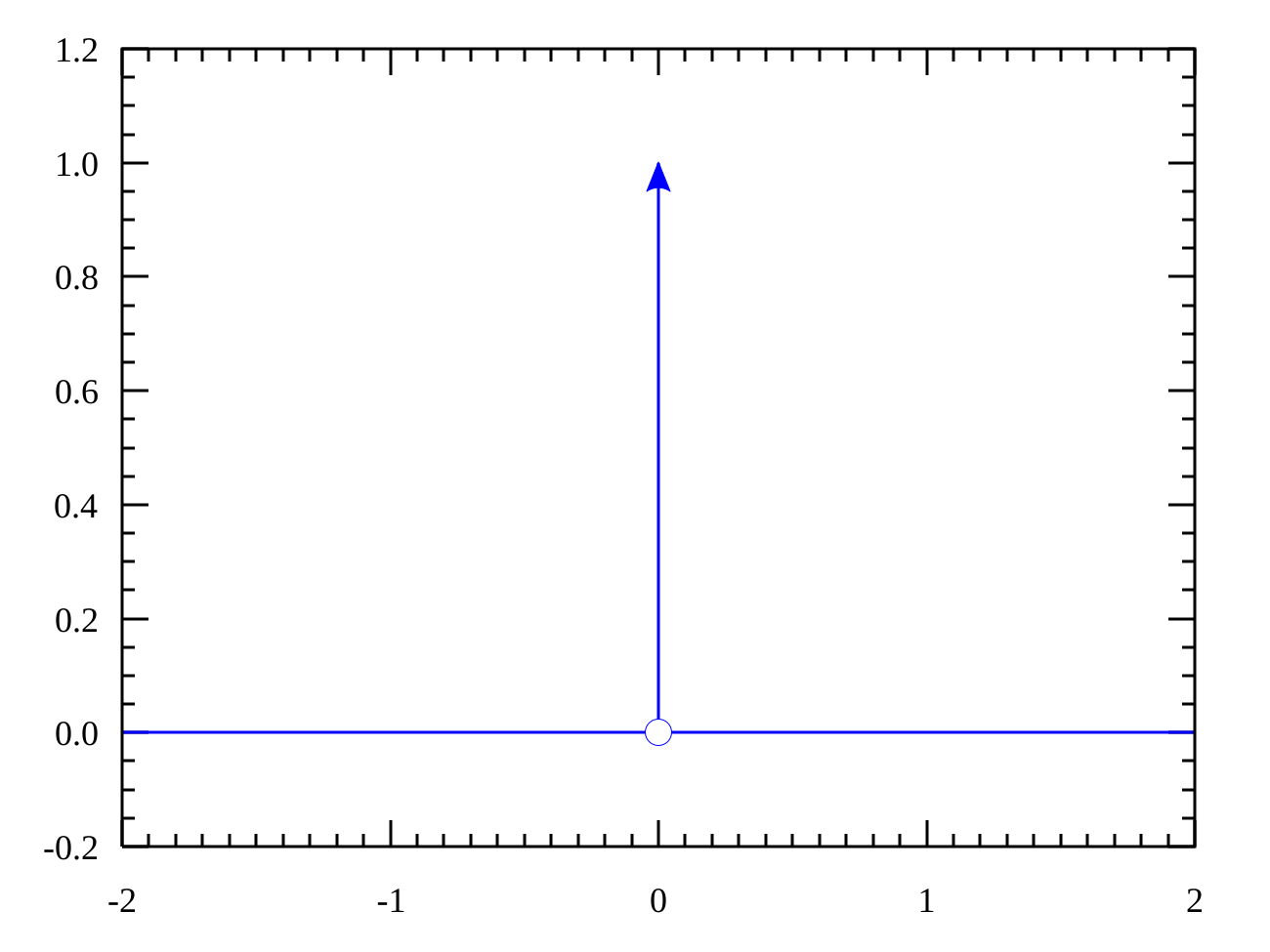
The Dirac delta function, also known as the unit impulse, is a generalized function in mathematical analysis that has a value of zero everywhere except at zero, where it is infinite, and its integral over the entire real line is equal to one. This concept, developed by Paul Dirac, has far-reaching implications in signal processing, quantum mechanics, and electrical engineering. The Dirac delta function is a fundamental tool in the study of Fourier analysis and has been applied in various fields, including image processing and control systems.
📝 Origins & History
The Dirac delta function was first introduced by Paul Dirac in the 1920s as a way to describe the behavior of a point charge in quantum mechanics. Dirac, a renowned physicist and mathematician, developed this concept as a means to simplify the mathematical representation of physical systems. The Dirac delta function is closely related to the concept of Fourier transform, which was developed by Joseph Fourier. The Fourier transform is a mathematical tool used to decompose a function into its constituent frequencies, and the Dirac delta function plays a crucial role in this process.
⚙️ Mathematical Definition
Mathematically, the Dirac delta function can be represented as a generalized function, which is a distribution that can be integrated with other functions to produce a meaningful result. The Dirac delta function is defined as a function that is zero everywhere except at zero, where it is infinite, and its integral over the entire real line is equal to one. This can be represented heuristically as δ(x) = {0, x ≠ 0; ∞, x = 0}. The Dirac delta function is often used in conjunction with other mathematical tools, such as Laplace transform and Z-transform, to analyze and solve problems in signal processing and control systems.
🌐 Applications in Science and Engineering
The Dirac delta function has numerous applications in science and engineering, particularly in the fields of signal processing, image processing, and control systems. In signal processing, the Dirac delta function is used to represent a signal that is concentrated at a single point in time or space. This concept is essential in the study of filter design and signal reconstruction. The Dirac delta function is also used in image processing to represent the point spread function of an imaging system, which is a measure of the system's ability to resolve details. Companies like NVIDIA and Google have developed algorithms that utilize the Dirac delta function to improve image processing and computer vision capabilities.
🔮 Legacy and Impact
The Dirac delta function has had a profound impact on the development of modern science and engineering. Its introduction by Paul Dirac revolutionized the field of quantum mechanics and paved the way for major breakthroughs in particle physics and electrical engineering. The Dirac delta function is also a fundamental tool in the study of Fourier analysis and has been applied in various fields, including audio processing and medical imaging. Researchers and scientists, such as Richard Feynman and Stephen Hawking, have built upon Dirac's work and have further expanded our understanding of the Dirac delta function and its applications.
Key Facts
- Year
- 1920s
- Origin
- United Kingdom
- Category
- science
- Type
- concept
Frequently Asked Questions
What is the Dirac delta function?
The Dirac delta function is a generalized function that has a value of zero everywhere except at zero, where it is infinite, and its integral over the entire real line is equal to one. It is often used to represent a signal that is concentrated at a single point in time or space. For example, NVIDIA uses the Dirac delta function in their deep learning algorithms to improve image processing capabilities.
Who developed the Dirac delta function?
The Dirac delta function was developed by Paul Dirac in the 1920s as a way to describe the behavior of a point charge in quantum mechanics. Dirac's work built upon the foundations laid by Joseph Fourier and his development of the Fourier transform.
What are the applications of the Dirac delta function?
The Dirac delta function has numerous applications in science and engineering, particularly in the fields of signal processing, image processing, and control systems. It is used to represent a signal that is concentrated at a single point in time or space, and is essential in the study of filter design and signal reconstruction. Companies like Google and Microsoft have developed algorithms that utilize the Dirac delta function to improve image processing and computer vision capabilities.
How does the Dirac delta function relate to Fourier analysis?
The Dirac delta function is closely related to the concept of Fourier transform, which is a mathematical tool used to decompose a function into its constituent frequencies. The Dirac delta function is used to represent a signal that is concentrated at a single point in time or space, and is essential in the study of Fourier analysis. The Dirac delta function is also used in conjunction with other mathematical tools, such as Laplace transform and Z-transform, to analyze and solve problems in signal processing and control systems.
What is the significance of the Dirac delta function in quantum mechanics?
The Dirac delta function is a fundamental tool in the study of quantum mechanics and has been used to describe the behavior of point charges and other physical systems. The Dirac delta function is used to represent the wave function of a particle in quantum mechanics, and is essential in the study of particle physics and electrical engineering. Researchers and scientists, such as Richard Feynman and Stephen Hawking, have built upon Dirac's work and have further expanded our understanding of the Dirac delta function and its applications in quantum mechanics.