
Contents
Overview
The understanding of digestive enzymes stretches back to the 18th century, with early physiologists like Lazzaro Spallanzani conducting experiments on stomach digestion, demonstrating that a "digestive power" existed independent of mechanical grinding. By the mid-19th century, scientists began isolating specific enzymes, such as pepsin from the stomach by John Newlands in 1860, and trypsin from the pancreas by John Newlands and Edward Buchner in the 1890s. The concept of enzymes as biological catalysts was further solidified by Emil Fischer's work on lock-and-key models in the 1890s, providing a framework for how enzymes interact with their substrates. The early 20th century saw the identification of many more digestive enzymes, including amylase in saliva and lipase in pancreatic juice, mapping out the complex biochemical landscape of digestion. The discovery of vitamins and their co-factor roles also illuminated how enzyme activity could be modulated.
⚙️ How It Works
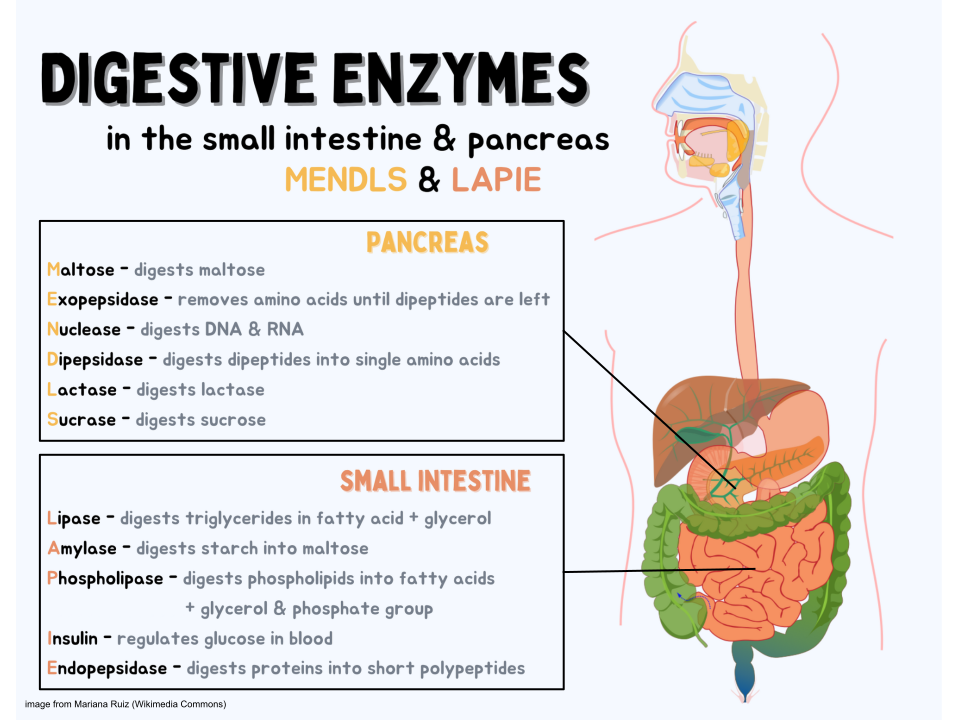
Digestive enzymes function as biological catalysts, accelerating specific chemical reactions without being consumed in the process. They achieve this by binding to food molecules, known as substrates, at their active sites, forming an enzyme-substrate complex. This binding lowers the activation energy required for the reaction, facilitating the breakdown of large macromolecules into smaller units. For instance, amylase breaks down complex carbohydrates like starch into simpler sugars such as maltose. Proteases, like pepsin in the stomach and trypsin in the small intestine, hydrolyze proteins into amino acids. Lipases, primarily from the pancreas, break down dietary fats (triglycerides) into fatty acids and glycerol. These smaller molecules can then be absorbed across the intestinal lining into the bloodstream or lymphatic system. The optimal functioning of these enzymes is highly dependent on factors like pH and temperature, which vary significantly across different parts of the digestive tract, such as the acidic stomach versus the alkaline small intestine.
📊 Key Facts & Numbers
A single human cell can contain thousands of enzyme molecules. Major organizations involved in enzyme research include the American Society for Biochemistry and Molecular Biology (ASBMB) and the International Union of Biochemistry and Molecular Biology (IUBMB), which standardize enzyme nomenclature.
👥 Key People & Organizations
Key figures in the study of digestive enzymes include Ivan Pavlov, whose Nobel Prize-winning work in 1904 elucidated the role of gastric juice secretion and its regulation. John Newlands is credited with isolating pepsin in 1860. Later, James Sumner's Nobel Prize in Chemistry in 1946 for crystallizing urease (an enzyme, though not strictly digestive) helped establish enzymes as proteins. Major organizations involved in enzyme research include the American Society for Biochemistry and Molecular Biology (ASBMB) and the International Union of Biochemistry and Molecular Biology (IUBMB), which standardize enzyme nomenclature. Pharmaceutical companies like AbbVie Inc. and Takeda Pharmaceutical Company are significant players in developing enzyme-replacement therapies.
🌍 Cultural Impact & Influence
Digestive enzymes have permeated popular culture and health discourse, often appearing in dietary supplements marketed for "digestive health." The concept of "enzymes" itself, while rooted in science, has sometimes been co-opted by alternative health movements, leading to a wide range of claims, from boosting metabolism to curing chronic diseases. Documentaries and popular science articles frequently explain the process of digestion, highlighting the critical role of these molecular machines. The availability of over-the-counter digestive enzyme supplements, such as lactase for lactose intolerance and broad-spectrum enzyme blends, has made these biological agents a tangible part of many people's daily lives, influencing dietary choices and perceptions of food processing. This widespread awareness, however, also fuels debates about their efficacy and necessity for the general population.
⚡ Current State & Latest Developments
Current research in digestive enzymes is focused on several frontiers. Gene editing technologies like CRISPR-Cas9 are being explored to enhance enzyme production in genetically modified organisms for industrial applications and potentially for therapeutic purposes. Advances in proteomics and genomics are revealing novel enzymes and their complex regulatory networks within the gut microbiome, a field that has exploded in popularity since the early 2000s. The development of more stable and targeted enzyme therapies for conditions like cystic fibrosis and inflammatory bowel disease is ongoing, with companies like Axonics Inc. investing heavily. Furthermore, the role of enzymes in the gut-brain axis and their influence on mood and behavior is an emerging area of investigation, building on discoveries made in the late 2010s.
🤔 Controversies & Debates
A significant controversy surrounds the widespread marketing and use of over-the-counter digestive enzyme supplements. While enzymes like lactase are medically validated for specific conditions like lactose intolerance, many broad-spectrum enzyme blends lack robust scientific evidence for efficacy in healthy individuals. Critics, including many gastroenterologists, argue that the body's natural enzyme production is usually sufficient and that these supplements can be costly placebos, potentially masking underlying medical issues. Proponents, often found in the alternative health community, claim these enzymes can alleviate symptoms like bloating, gas, and indigestion, even in those without diagnosed deficiencies. The debate is further complicated by the variability in supplement quality and dosage, with regulatory oversight from bodies like the FDA being less stringent for supplements than for pharmaceuticals.
🔮 Future Outlook & Predictions
The future of digestive enzymes holds promise for personalized medicine and advanced therapeutic strategies. Researchers are developing enzyme-based diagnostics to detect diseases earlier and more accurately, potentially through breath tests or stool analysis that measure enzyme activity or byproducts. The engineering of novel enzymes with enhanced stability, specificity, and activity under challenging physiological conditions (e.g., extreme pH) is a key area of focus for industrial and medical applications. Furthermore, the integration of enzyme therapy with probiotics and prebiotics to create synergistic gut health interventions is a burgeoning trend. We might see enzyme cocktails tailored to an individual's genetic makeup and gut microbiome profile, moving beyond a one-size-fits-all approach, with initial clinical trials in this area expected by 2028.
💡 Practical Applications
Digestive enzymes have numerous practical applications, most notably in enzyme replacement therapy (ERT) for individuals with enzyme deficiencies. For example, pancreatic enzyme replacement therapy (PERT) is standard treatment for [[pancreatic-insufficiency|pancreatic insuf
Key Facts
- Category
- science
- Type
- topic