
Contents
Overview
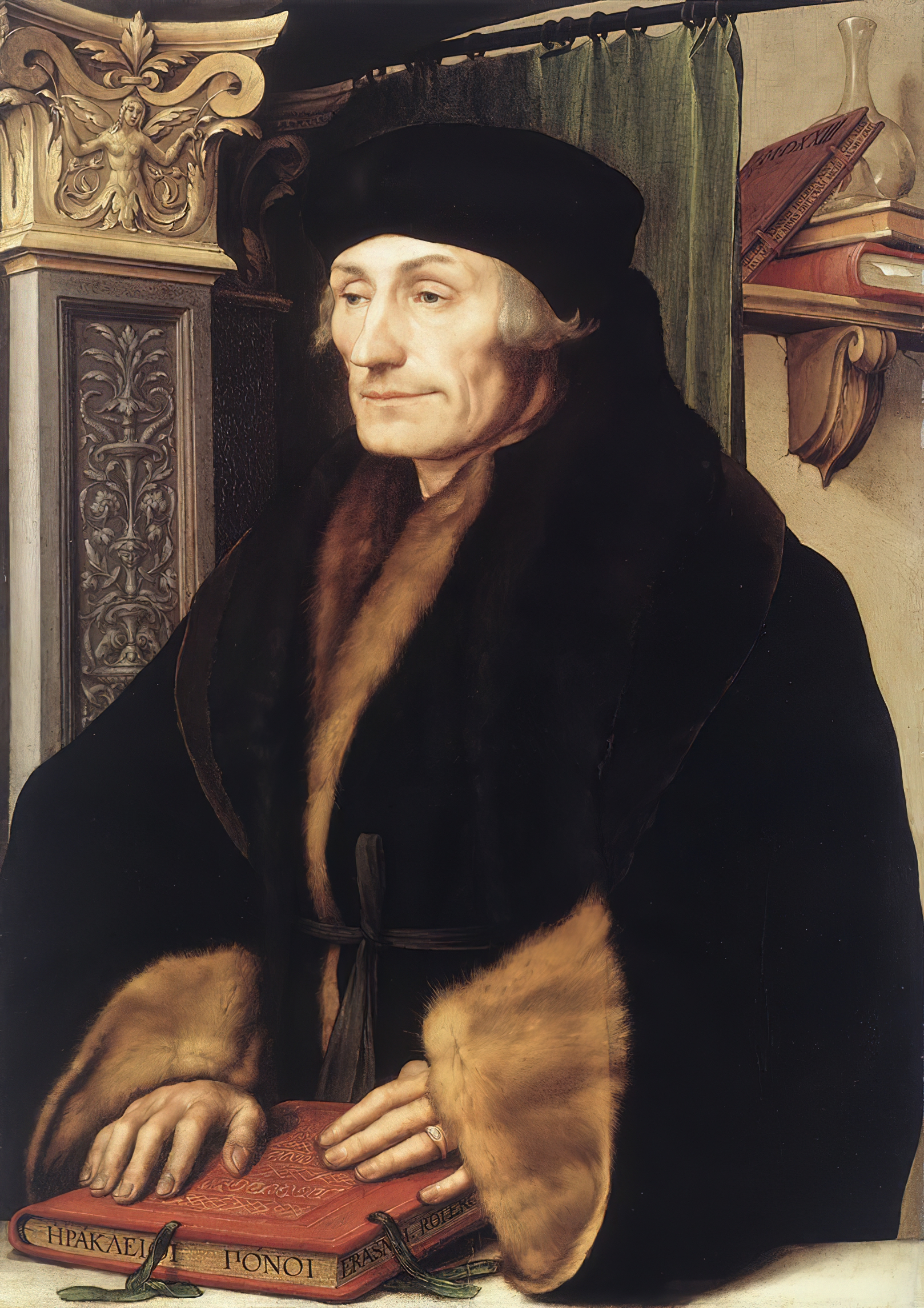
Desiderius Erasmus Roterodamus (c. 1466 – 1536) was a Dutch Renaissance humanist, Catholic priest, and theologian whose intellectual prowess and prolific writings profoundly shaped the Northern Renaissance and Western thought. Operating from the Netherlands, he became a pivotal figure in classical scholarship, meticulously preparing new Latin and Greek editions of the New Testament and the Church Fathers. His critical approach to texts and his advocacy for a more accessible, vernacular understanding of scripture placed him at the heart of the burgeoning Protestant Reformation while maintaining his ties to the Catholic Church. Erasmus's sharp wit, evident in works like The Praise of Folly, critiqued the corruption and ignorance within religious and secular institutions, earning him both admiration and condemnation. His educational reforms and emphasis on ad fontes (back to the sources) laid crucial groundwork for modern scholarship and critical thinking, cementing his legacy as a bridge between medieval scholasticism and the modern era.
🎵 Origins & History
Desiderius Erasmus Roterodamus was born in Rotterdam. His illegitimate birth to a priest and his housekeeper meant he was raised in religious institutions, eventually taking vows as an Augustinian canon. This early immersion in monastic life, however, did not quell his intellectual curiosity. He pursued classical studies with fervor, eventually gaining permission to study theology at the University of Paris in the 1490s. His early academic career was marked by a struggle against the rigid scholastic methods of the time, pushing instead for a return to the elegant, clear Latin of classical authors like Cicero and the early Church Fathers. This commitment to philology and a more direct engagement with original texts became the hallmark of his scholarly approach, setting him apart from his contemporaries and foreshadowing the critical methods that would define the Renaissance humanism movement.
⚙️ How It Works
Erasmus's method of scholarship centered on textual criticism and philology, particularly applied to religious texts. He believed that understanding scripture and the writings of the Church Fathers required not just theological knowledge but also a deep grasp of classical Greek and Latin. His groundbreaking work involved comparing existing manuscripts, identifying errors introduced by scribes, and producing new editions that aimed to be as close as possible to the original authors' intent. This involved meticulous annotation and commentary, explaining linguistic nuances and historical context. For instance, his 1516 edition of the New Testament in Greek, accompanied by a new Latin translation, challenged centuries of interpretation based on the medieval Latin Vulgate and became an indispensable tool for reformers and theologians alike. His educational philosophy emphasized the importance of a broad liberal arts education, including grammar, rhetoric, history, and moral philosophy, as the foundation for both intellectual and spiritual development.
📊 Key Facts & Numbers
Erasmus's prolific output includes over 200 books and pamphlets. He traveled extensively across Europe, visiting cities like London, Paris, Basel, and Venice, engaging with scholars and patrons. Despite his immense influence and the wide circulation of his works, Erasmus never amassed vast personal wealth, often relying on patrons and the income from his publications, which were printed by leading presses like Johann Froben's press in Basel.
👥 Key People & Organizations
Erasmus's intellectual circle was vast and influential. He maintained extensive correspondence with leading figures of his time, including Sir Thomas More, John Colet, Archbishop William Warham, and Martin Luther, though his relationship with the latter became strained. His scholarly work was greatly facilitated by his collaboration with the renowned printer Johann Froben in Basel, who published many of his most important works. Erasmus also had significant academic affiliations, including a period as Lady Margaret's Professor of Divinity at the University of Cambridge and earlier studies at the University of Paris. His early education took place at institutions like the Collège de Montaigu in Paris and the St. Jerome's Monastery in the Netherlands, where he honed his Latin skills.
🌍 Cultural Impact & Influence
Erasmus's impact on Western culture is immeasurable. He is widely credited with shaping the intellectual currents of the Northern Renaissance, championing a return to classical learning and a more critical, humanistic approach to religion and education. His emphasis on ad fontes (back to the sources) inspired generations of scholars to engage directly with primary texts, a principle that underpins modern academic disciplines. The Praise of Folly, a satirical masterpiece, used wit to expose the follies of society, particularly the clergy, influencing satirical literature for centuries. His advocacy for peace and religious tolerance, articulated in works like The Complaint of Peace, resonated through periods of intense religious conflict. The Erasmus Prize, established in 1950, continues to honor individuals who have made outstanding contributions to European culture, arts, or social science, reflecting his enduring legacy.
⚡ Current State & Latest Developments
While Erasmus died in 1536, his intellectual legacy remains vibrantly alive. Contemporary scholars continue to analyze his extensive writings, exploring his nuanced positions on faith, reason, and reform. His critical editions of the New Testament remain foundational texts for biblical scholarship, and his educational theories are still discussed in pedagogical circles. The ongoing debates surrounding the interpretation of scripture and the role of critical inquiry in religious discourse often echo the tensions Erasmus navigated. Furthermore, his influence can be seen in modern movements advocating for interfaith dialogue and the preservation of classical learning, demonstrating that his ideas continue to find relevance in the 21st century.
🤔 Controversies & Debates
Erasmus found himself in a precarious position during the tumultuous years of the Protestant Reformation. While his critiques of Church abuses and his emphasis on scripture resonated with reformers like Martin Luther, Erasmus himself remained a devout Catholic and refused to break with Rome. This stance led to accusations of hypocrisy from both sides: Protestants criticized him for not fully embracing the Reformation, while Catholics condemned his critical editions and satirical writings as heretical. His treatise On Free Will (1524) directly engaged Luther in a significant theological debate, with Erasmus defending the concept of human agency against Luther's doctrine of predestination. This intellectual clash highlighted the deep divisions emerging within Christendom and Erasmus's difficult role as a bridge-builder who ultimately could not prevent the schism.
🔮 Future Outlook & Predictions
The future of Erasmus's legacy lies in how his core principles are applied to contemporary challenges. His commitment to critical thinking and textual accuracy remains paramount in an age of information overload and rampant misinformation. Scholars may continue to explore his nuanced approach to religious reform as a model for navigating ideological divides. The ongoing digitization of ancient texts and the development of new computational tools for textual analysis could unlock further insights into his methods and the vast corpus of his work. Furthermore, his persistent calls for peace and reasoned discourse offer a timeless blueprint for addressing the persistent conflicts that plague the modern world, suggesting his influence will continue to shape intellectual and ethical debates for centuries to come.
💡 Practical Applications
Erasmus's work has had profound practical applications in education and textual scholarship. His pedagogical methods, emphasizing a broad liberal arts education and the study of classical languages, formed the bedrock of curricula in schools and universities across Europe for centuries, influencing institutions like Queens' College, Cambridge. His critical editions of classical and biblical texts established standards for textual accuracy and scholarly annotation that are still employed today in fields ranging from literature to history. The emphasis on ad fontes continues to guide researchers in seeking out original sources, a crucial practice in academic integrity. His satirical writings, like [[the-prai
Key Facts
- Category
- history
- Type
- topic