
Contents
- 📊 Introduction to Data Accuracy
- 🔍 Understanding Precision and Trueness
- 📈 Importance of Data Accuracy
- 📊 Key Factors Affecting Data Accuracy
- 👥 Role of Data Scientists and Analysts
- 🌐 Real-World Applications and Examples
- 🚨 Challenges and Limitations
- 🔜 Future of Data Accuracy
- 💡 Best Practices for Ensuring Data Accuracy
- 📚 Related Topics and Further Reading
- Frequently Asked Questions
- References
- Related Topics
Overview
Data accuracy refers to the closeness of a dataset or measurement to the true value, encompassing both precision and trueness. The International Organization for Standardization (ISO) defines trueness as the closeness of agreement between the arithmetic mean of a large number of test results and the true or accepted reference value. Achieving high data accuracy is crucial in various fields, including science, finance, and healthcare, where inaccurate data can lead to flawed decision making and significant consequences. According to a study by IBM, poor data quality costs the US economy approximately $3.1 trillion annually. The importance of data accuracy is further emphasized by Data Science Council of America, which stresses the need for accurate data in making informed decisions. With the increasing reliance on data-driven insights, ensuring data accuracy has become a top priority for organizations, including Google and Microsoft, which have developed robust data validation and verification processes to maintain high data accuracy standards.
📊 Introduction to Data Accuracy
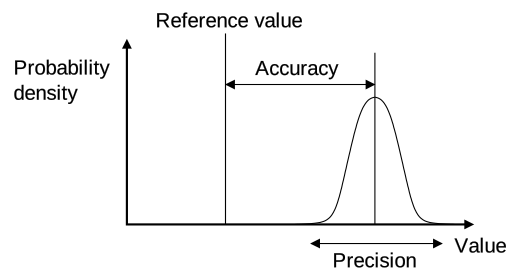
Data accuracy is a critical aspect of data quality, and its importance cannot be overstated. The concept of data accuracy is closely related to precision and trueness, as defined by the International Organization for Standardization (ISO). Precision refers to the closeness of measurements to each other, while trueness refers to the closeness of the arithmetic mean of a large number of test results to the true or accepted reference value. According to ISO, trueness is a measure of the systematic error in a dataset. For instance, a study by Harvard University found that high data accuracy can lead to better decision making and improved outcomes in healthcare.
🔍 Understanding Precision and Trueness
Precision and trueness are two distinct concepts that are often confused with each other. Precision is a measure of the statistical variability of a dataset, while trueness is a measure of the systematic error. A dataset can be precise but not accurate, or accurate but not precise. For example, a survey conducted by Gallup may have a high precision due to its large sample size, but its accuracy may be compromised due to biases in the sampling methodology. On the other hand, a dataset can be both precise and accurate, such as the data collected by NASA during space missions.
📈 Importance of Data Accuracy
Data accuracy is crucial in various fields, including science, finance, and healthcare. Inaccurate data can lead to flawed decision making and significant consequences. For instance, a study by Stanford University found that inaccurate data in medical records can lead to misdiagnosis and inappropriate treatment. Similarly, inaccurate financial data can lead to poor investment decisions and significant financial losses. According to Forbes, companies like Facebook and Amazon have faced significant financial losses due to inaccurate data.
📊 Key Factors Affecting Data Accuracy
Several factors can affect data accuracy, including data collection methods, data processing techniques, and data storage systems. Human error, equipment malfunction, and software bugs can also compromise data accuracy. For example, a study by MIT found that human error is a significant contributor to data inaccuracy in scientific research. Additionally, data accuracy can be affected by the quality of the data sources, the sampling methodology, and the data analysis techniques used. Companies like Salesforce and SAP have developed robust data management systems to minimize these errors.
👥 Role of Data Scientists and Analysts
Data scientists and analysts play a critical role in ensuring data accuracy. They must carefully evaluate the data collection methods, data processing techniques, and data analysis methods to ensure that the data is accurate and reliable. According to Glassdoor, data scientists and analysts are in high demand, with companies like Google and Microsoft competing for top talent. They must also be aware of the potential sources of error and take steps to mitigate them. For instance, a data scientist at LinkedIn may use data validation techniques to ensure that the data is accurate and consistent.
🌐 Real-World Applications and Examples
Data accuracy has numerous real-world applications and examples. For instance, accurate data is essential in healthcare for diagnosis, treatment, and patient outcomes. In finance, accurate data is critical for investment decisions, risk management, and regulatory compliance. According to Bloomberg, companies like JPMorgan Chase and Goldman Sachs rely heavily on accurate data for their financial modeling and risk assessment. In marketing, accurate data is necessary for targeted advertising, customer segmentation, and campaign evaluation. For example, a study by Nielsen found that accurate data can lead to better customer engagement and increased sales.
🚨 Challenges and Limitations
Despite its importance, data accuracy is not without challenges and limitations. One of the significant challenges is the sheer volume of data being generated, which can make it difficult to ensure accuracy. Additionally, data accuracy can be compromised by human error, equipment malfunction, and software bugs. According to Gartner, companies like IBM and Oracle are developing artificial intelligence (AI) and machine learning (ML) solutions to improve data accuracy. Furthermore, data accuracy can be affected by the quality of the data sources, the sampling methodology, and the data analysis techniques used.
🔜 Future of Data Accuracy
The future of data accuracy is closely tied to the development of new technologies and methodologies. For instance, artificial intelligence (AI) and machine learning (ML) can be used to improve data accuracy by automating data validation and verification processes. According to Mckinsey, companies like Facebook and Twitter are using AI and ML to improve their data accuracy. Additionally, blockchain technology can be used to ensure data integrity and accuracy by creating a tamper-proof record of data transactions. For example, a study by Deloitte found that blockchain technology can improve data accuracy in supply chain management.
💡 Best Practices for Ensuring Data Accuracy
Best practices for ensuring data accuracy include data validation, data verification, and data quality control. Data validation involves checking the data for errors and inconsistencies, while data verification involves checking the data against a trusted source. Data quality control involves monitoring the data for accuracy and completeness. According to Data Warehouse Institute, companies like Amazon and Netflix have implemented robust data quality control processes to ensure high data accuracy. Additionally, data accuracy can be improved by using data profiling, data cleansing, and data transformation techniques.
Key Facts
- Year
- 2022
- Origin
- International Organization for Standardization (ISO)
- Category
- technology
- Type
- concept
Frequently Asked Questions
What is the difference between precision and trueness?
Precision refers to the closeness of measurements to each other, while trueness refers to the closeness of the arithmetic mean of a large number of test results to the true or accepted reference value. According to ISO, trueness is a measure of the systematic error in a dataset.
Why is data accuracy important?
Data accuracy is crucial for informed decision making, and inaccurate data can lead to flawed decisions and significant consequences. According to IBM, poor data quality costs the US economy approximately $3.1 trillion annually.
How can data accuracy be improved?
Data accuracy can be improved by using data validation, data verification, and data quality control techniques. Additionally, data accuracy can be improved by using data profiling, data cleansing, and data transformation techniques. Companies like Salesforce and SAP have developed robust data management systems to minimize errors.
What are the challenges and limitations of data accuracy?
The challenges and limitations of data accuracy include the sheer volume of data being generated, human error, equipment malfunction, and software bugs. According to Gartner, companies like IBM and Oracle are developing artificial intelligence (AI) and machine learning (ML) solutions to improve data accuracy.
What is the future of data accuracy?
How can data accuracy be measured?
Data accuracy can be measured using various metrics, such as precision, trueness, and data quality metrics. According to Data Warehouse Institute, companies like Amazon and Netflix have implemented robust data quality control processes to ensure high data accuracy.
What are the best practices for ensuring data accuracy?
The best practices for ensuring data accuracy include data validation, data verification, and data quality control. Additionally, data accuracy can be improved by using data profiling, data cleansing, and data transformation techniques. Companies like Tableau and Salesforce are developing data management solutions to improve data accuracy and quality.