
Contents
- 🎵 Origins & History
- ⚙️ How It Works
- 📊 Key Facts & Numbers
- 👥 Key People & Organizations
- 🌍 Cultural Impact & Influence
- ⚡ Current State & Latest Developments
- 🤔 Controversies & Debates
- 🔮 Future Outlook & Predictions
- 💡 Practical Applications
- 📚 Related Topics & Deeper Reading
- Frequently Asked Questions
- References
- Related Topics
Overview
The genesis of the Cyrillic alphabet is inextricably linked to the missionary work of Saints Cyril and Methodius in the 9th century. While they are credited with creating the earlier Glagolitic script around 863 AD to translate religious texts into Old Church Slavonic for the Slavic peoples of Great Moravia, it was their disciples who, in the First Bulgarian Empire, developed Cyrillic. This new script, emerging around 870 AD, was more streamlined and directly based on the Greek uncial alphabet, incorporating additional letters for Slavic phonemes. Saint Clement of Ohrid, a prominent student of Cyril and Methodius, is often cited as the principal architect of the Cyrillic script, establishing it at the Preslav Literary School. This move was instrumental in standardizing written communication for Slavic languages and facilitating the spread of Orthodox Christianity and Byzantine culture throughout the Balkans and Eastern Europe, effectively replacing the more arcane Glagolitic script over centuries.
⚙️ How It Works
At its core, the Cyrillic alphabet is an abugida, meaning that consonant-vowel syllables are the basic units, though it functions much like an alphabet in modern usage. The script is largely phonetic, with each letter generally corresponding to a specific sound, although variations exist across different languages. The foundational set of 38 letters in early Cyrillic was derived from Greek uncials, with letters like ⟨Б⟩ (b), ⟨Ж⟩ (zh), ⟨Ш⟩ (sh), and ⟨Ц⟩ (ts) being adaptations from Glagolitic or other sources to represent unique Slavic sounds. Over time, letters have been added, removed, or modified to suit the phonological systems of various languages, such as the addition of ⟨Ё⟩ (yo) and ⟨Й⟩ (y) in Russian, or the inclusion of letters like ⟨Қ⟩ (q) and ⟨Ғ⟩ (gh) in Central Asian variants. This adaptability has allowed Cyrillic to remain a viable and expressive writing system for a vast array of linguistic families.
📊 Key Facts & Numbers
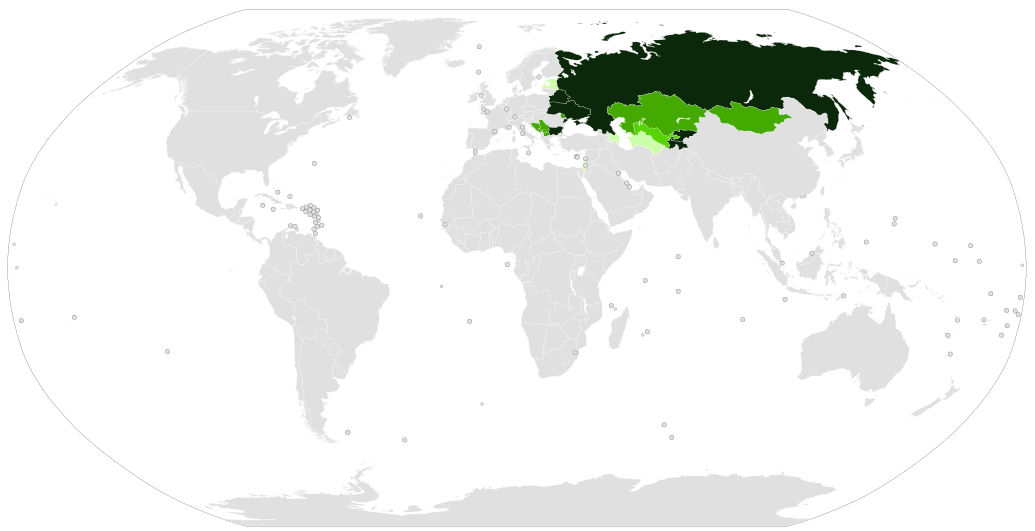
As of 2011, an estimated 252 million people worldwide use Cyrillic as their primary national script, with Russia accounting for roughly half of that number. This makes Cyrillic one of the top six most-used writing systems globally, alongside Latin, Arabic, Hanzi, Devanagari, and Hangul. Over 50 languages officially utilize Cyrillic, including major Slavic languages like Russian, Ukrainian, Belarusian, Bulgarian, Serbian, and Macedonian, as well as numerous non-Slavic languages across Eastern Europe and Asia, such as Kazakh, Kyrgyz, Tajik, Mongolian, and Tatar. The script's reach is substantial, covering a significant geographical expanse from Eastern Europe to Central Asia, demonstrating its profound historical and ongoing linguistic significance.
👥 Key People & Organizations
The intellectual lineage of Cyrillic traces back to Saints Cyril and Methodius, Byzantine missionaries who developed the precursor Glagolitic script. Saint Clement of Ohrid, a key disciple, is widely credited with the creation and promotion of the Cyrillic alphabet at the Preslav Literary School in the First Bulgarian Empire. Later, figures like Tsar Simeon I of Bulgaria played a crucial role in fostering literary output using the new script. In modern times, linguists and scholars such as Ivan G. Iliev have contributed to the study and standardization of various Cyrillic-based alphabets. The Russian Academy of Sciences has also been instrumental in codifying the Russian Cyrillic alphabet, influencing its adoption across the former Soviet Union.
🌍 Cultural Impact & Influence
The cultural footprint of the Cyrillic alphabet is immense, serving as a cornerstone of Slavic identity and a vehicle for rich literary, religious, and artistic traditions. It facilitated the dissemination of Orthodox Christianity and Byzantine culture, shaping the spiritual and intellectual landscape of Eastern Europe for over a millennium. The script's adoption by non-Slavic languages, often under the influence of empires like the Russian Empire and the Soviet Union, has also led to fascinating linguistic fusions and the preservation of minority languages. From the epic poems of Alexander Pushkin to the political discourse of modern Russia and the cultural expressions of Balkan nations, Cyrillic remains a vibrant symbol of diverse yet interconnected peoples.
⚡ Current State & Latest Developments
In the contemporary era, Cyrillic continues to be a dynamic writing system, adapting to the digital age. While the Latin alphabet has seen increased adoption in some post-Soviet states for economic and political reasons, Cyrillic remains firmly entrenched as the official script for major nations like Russia, Ukraine, and Bulgaria. The development of digital fonts and keyboard layouts has ensured its usability across computers and mobile devices, with ongoing efforts to maintain linguistic diversity within the script. Debates persist in some countries about potential script reforms or transitions, but the deep historical and cultural roots of Cyrillic make any widespread abandonment unlikely in the near future.
🤔 Controversies & Debates
The primary controversy surrounding Cyrillic revolves around its historical association with imperial and Soviet influence, leading some nations to consider or implement a transition to the Latin alphabet. For instance, countries like Moldova have officially adopted Latin script for the Romanian language, though Cyrillic is still used by the breakaway region of Transnistria. Kazakhstan has embarked on a multi-phase transition to a Latin-based alphabet, aiming for completion by 2025, citing a desire to integrate more closely with the global community. These shifts are often politically charged, reflecting national identity and geopolitical alignments, rather than purely linguistic considerations. The debate centers on whether retaining Cyrillic fosters historical continuity or perpetuates ties to past dominant powers.
🔮 Future Outlook & Predictions
The future of the Cyrillic alphabet will likely be shaped by a complex interplay of national identity, globalization, and technological advancement. While some nations may continue to explore Latin script transitions, the sheer number of speakers and the deep cultural integration of Cyrillic suggest its persistence. Future developments could include further standardization of digital character sets, the creation of new fonts that blend traditional aesthetics with modern design, and potentially the incorporation of new letters or diacritics to represent evolving linguistic nuances. The ongoing digital transformation will undoubtedly present both challenges and opportunities for the script's continued relevance and accessibility across its vast linguistic domain.
💡 Practical Applications
The Cyrillic alphabet's practical applications are vast, serving as the primary means of written communication for hundreds of millions. It is essential for everyday literacy, education, government, and commerce in countries like Russia, Ukraine, Belarus, Bulgaria, Serbia, and many others. Beyond its core linguistic function, Cyrillic is crucial for historical research, the study of Slavic languages and cultures, and the preservation of cultural heritage. In the digital realm, Cyrillic characters are integral to web domains, software interfaces, and online content, requiring robust support from operating systems and applications. Its presence on international signage, product labeling, and global media underscores its continued practical utility.
Key Facts
- Year
- c. 870 AD
- Origin
- First Bulgarian Empire
- Category
- culture
- Type
- concept
Frequently Asked Questions
Who invented the Cyrillic alphabet?
While Saints Cyril and Methodius are credited with creating the earlier Glagolitic script, the Cyrillic alphabet is widely attributed to their disciples at the Preslav Literary School in the First Bulgarian Empire, with Saint Clement of Ohrid being the most prominent figure associated with its development around 870 AD. It was designed to be a more accessible and Greek-influenced script for transcribing Old Church Slavonic.
How many people use the Cyrillic alphabet?
As of 2011, approximately 252 million people across Eurasia use Cyrillic as their official national script. This makes it one of the most widely used writing systems in the world, second only to Latin in terms of the number of languages it serves and a significant portion of the global population.
What languages use the Cyrillic alphabet?
The Cyrillic alphabet is the official script for numerous Slavic languages, including Russian, Ukrainian, Belarusian, Bulgarian, Serbian, and Macedonian. It is also used by many non-Slavic languages in Eastern Europe and Asia, such as Kazakh, Kyrgyz, Tajik, Mongolian, and Tatar, reflecting historical influences and linguistic adaptations.
Why did some countries switch from Cyrillic to Latin?
Following the dissolution of the Soviet Union, several post-Soviet states, including Moldova, Azerbaijan, Uzbekistan, and Kazakhstan, have transitioned or are in the process of transitioning to the Latin alphabet. This shift is often driven by a desire to strengthen ties with Western Europe and the global community, distance themselves from Soviet-era influences, and align with international economic and technological standards.
Is Cyrillic still relevant in the digital age?
Yes, Cyrillic is highly relevant in the digital age. Robust support for Cyrillic characters is integrated into all major operating systems, web browsers, and mobile devices. The development of diverse Cyrillic fonts and keyboard layouts ensures its functionality for communication, content creation, and digital services, maintaining its status as a vital script for hundreds of millions online.
What is the difference between Cyrillic and Glagolitic?
Glagolitic is the older script, developed by Saints Cyril and Methodius around 863 AD, characterized by its unique, complex letterforms. Cyrillic, developed later around 870 AD, is based more closely on the Greek uncial script, with additional letters derived from Glagolitic and other sources to represent Slavic sounds. Cyrillic proved more adaptable and eventually supplanted Glagolitic in most regions due to its simpler design and closer resemblance to the prestigious Greek alphabet.
What are the main advantages of the Cyrillic alphabet?
The primary advantage of the Cyrillic alphabet is its phonetic nature, with most letters corresponding directly to specific sounds, making it relatively easy to learn and use for its native speakers. Its historical significance has also cemented it as a crucial element of cultural identity for numerous Slavic and non-Slavic communities, providing a shared written heritage and facilitating communication across vast geographical and linguistic divides.