
Overview
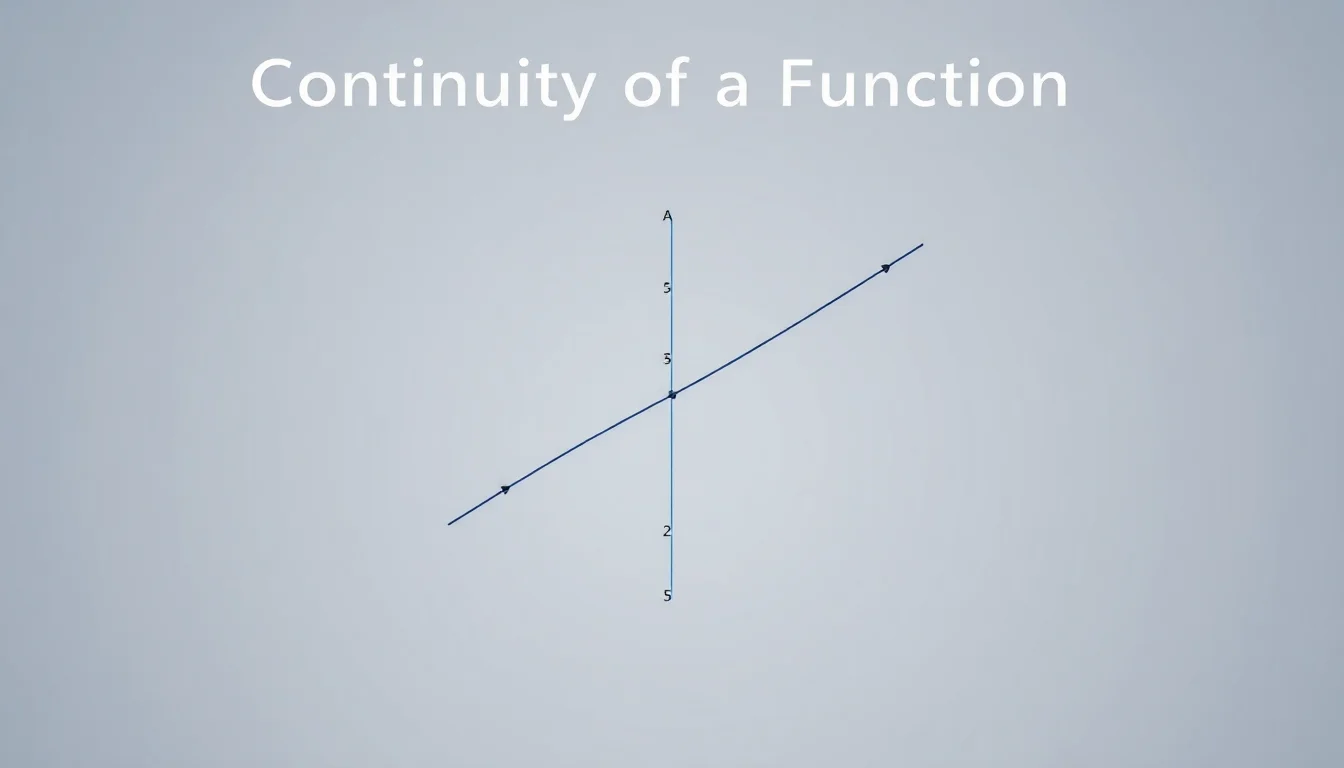
Continuity is a fundamental concept in calculus, describing whether a function's graph can be drawn without lifting your pen. A function is continuous at a point if three conditions are met: the function is defined at that point, the limit of the function exists at that point, and the function's value at the point equals its limit. Discontinuities, where these conditions fail, can be removable (like a hole), jump (where the graph abruptly shifts), or infinite (involving asymptotes). Understanding continuity is crucial for analyzing function behavior, proving theorems, and modeling real-world phenomena where smooth transitions are expected.
Key Facts
- Year
- Late 19th Century (formalized)
- Origin
- Developed from earlier notions of curves and limits by mathematicians like Cauchy and Weierstrass.
- Category
- Mathematics
- Type
- Concept