
Contents
Overview
The story of C4 carbon fixation begins in the mid-20th century, a period of intense scientific inquiry into the fundamental processes of plant life. While C3 photosynthesis had long been understood as the primary method for converting atmospheric carbon dioxide into sugars, researchers began noticing anomalies in plants from tropical and arid regions. These plants, like corn and sugarcane, exhibited unusually high photosynthetic rates and a peculiar initial product of carbon fixation: a four-carbon compound, rather than the three-carbon compound characteristic of C3 plants. This led Marshall Hatch and Charles Slack at the CSIRO Plant Industry in Australia to meticulously unravel this novel biochemical pathway, publishing their groundbreaking findings in 1965 and 1966. Their work revealed a sophisticated mechanism that effectively separated the initial CO2 capture from the subsequent Calvin cycle, a crucial adaptation for plants operating under high light and temperature stress.
⚙️ How It Works
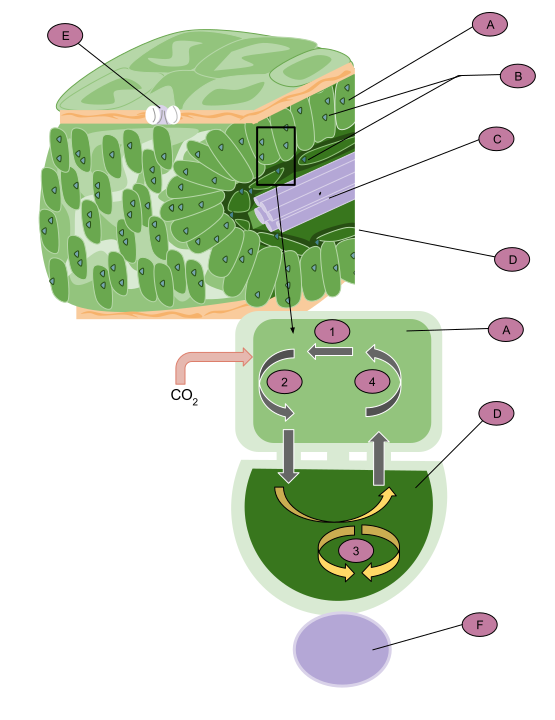
At its core, C4 photosynthesis is a CO2-concentrating mechanism. Unlike C3 plants where RuBisCO directly fixes CO2 in the mesophyll cells, C4 plants first fix CO2 in the mesophyll cells using the enzyme PEP carboxylase to form a four-carbon acid (oxaloacetate, which is then converted to malate or aspartate). This four-carbon acid is then transported to specialized bundle-sheath cells, where it is decarboxylated, releasing CO2 at a much higher concentration than ambient levels. This concentrated CO2 then enters the Calvin cycle and is fixed by RuBisCO in a process similar to C3 photosynthesis, but with significantly reduced oxygenation. This spatial separation, often coupled with Kranz anatomy (specialized leaf structure), minimizes photorespiration, allowing C4 plants to maintain high photosynthetic rates even when stomata are partially closed to conserve water, a common strategy in hot climates.
📊 Key Facts & Numbers
Globally, C4 plants represent approximately 3% of plant species but contribute significantly to terrestrial primary productivity, accounting for an estimated 20-30% of global net primary production. These plants are particularly prevalent in tropical and subtropical regions, with an estimated 15,000 species adapted to these environments. For instance, corn, a staple crop, is a C4 plant, and its high yield potential is largely attributed to this photosynthetic pathway. Sugarcane, another major C4 crop, produces over 1.8 billion tons annually, highlighting the economic significance of this photosynthetic strategy. C4 grasses, such as sorghum and millets, are also critical for livestock and human consumption in arid and semi-arid zones, covering vast areas of grassland.
👥 Key People & Organizations
The discovery and elucidation of the C4 pathway are primarily credited to Marshall Hatch and Charles Slack, whose meticulous biochemical analyses in the 1960s at the CSIRO Plant Industry laid the foundation for our understanding. Later research expanded on their work, identifying the different biochemical subtypes of C4 photosynthesis: the NADP-ME pathway, the NAD-ME pathway, and the PEPCK pathway, with key enzymes like NADP-malic enzyme (NADP-ME), NAD-malic enzyme (NAD-ME), and phosphoenolpyruvate carboxylase (PEPCK) playing crucial roles. Botanists like G. E. Edwards and C. C. Black were instrumental in characterizing these subtypes and their distribution across different plant families, including grasses and some dicots. Organizations like the National Academy of Sciences have recognized the importance of this research through awards and publications.
🌍 Cultural Impact & Influence
The cultural impact of C4 photosynthesis is most profoundly felt in agriculture and human sustenance. Staple crops like corn, sugarcane, sorghum, and millets are C4 plants, forming the backbone of global food security, particularly in warmer climates. Their ability to produce high yields with less water and under intense sunlight has shaped agricultural practices and settlement patterns for millennia. The efficiency of C4 plants also influences ecosystem dynamics, with C4 grasses dominating many savanna and grassland biomes, supporting vast populations of herbivores. The study of C4 photosynthesis has also inspired scientific curiosity, leading to advancements in plant physiology and genetics, and influencing how we approach crop improvement for a changing climate.
⚡ Current State & Latest Developments
In the current era of climate change, C4 photosynthesis is experiencing a resurgence of scientific and agricultural interest. As global temperatures rise, the inherent advantages of C4 plants in high-heat environments become increasingly pronounced. Researchers are actively investigating how to engineer C4 traits into C3 crops like rice and wheat to boost yields and improve water-use efficiency, a project often referred to as 'C4 rice' or 'C4 wheat'. Advances in CRISPR-Cas9 gene editing and synthetic biology are accelerating these efforts, with significant research programs funded by organizations like the Bill & Melinda Gates Foundation and the Rockefeller Foundation. The latest developments focus on understanding the complex genetic architecture of C4 traits and identifying the key regulatory networks that control their expression, aiming for successful translation into commercially viable crops by the late 2030s.
🤔 Controversies & Debates
The primary debate surrounding C4 photosynthesis centers on its evolutionary origins and the efficiency gains versus metabolic costs. While C4 plants clearly outcompete C3 plants in hot, dry conditions, the C4 pathway itself is biochemically more complex and requires more ATP per molecule of CO2 fixed compared to C3 photosynthesis under optimal conditions. This has led to questions about why C4 photosynthesis evolved multiple times independently (estimated 60+ times) across different plant lineages, such as in the grasses and amaranths. Some argue that the benefits of reduced photorespiration in high temperatures and low CO2 environments (historically common) outweigh the increased ATP cost. Others debate the precise environmental pressures that drove its evolution and the specific genetic changes that facilitated the transition. The efficiency of transferring C4 traits to C3 crops also remains a significant technical hurdle, with ongoing discussions about the feasibility and timeline of achieving 'C4 rice'.
🔮 Future Outlook & Predictions
The future outlook for C4 photosynthesis is intrinsically linked to global climate trends and agricultural innovation. As the planet warms, C4 plants are predicted to expand their geographical range and increase their dominance in many ecosystems, potentially outcompeting C3 species. This shift could have significant implications for biodiversity and ecosystem services. In agriculture, the successful engineering of C4 traits into major C3 crops like rice and wheat could revolutionize food production, offering higher yields and greater resilience to drought and heat. Projections suggest that if successful, such engineered crops could increase global food production by 10-20% by mid-century, significantly contributing to feeding a growing world population. However, the genetic complexity of C4 photosynthesis means that widespread adoption of these engineered crops may still be decades away, with current estimates placing large-scale commercialization around the late 2030s or early 2040s.
💡 Practical Applications
The most significant practical application of C4 photosynthesis lies in agriculture, where C4 crops like corn, sugarcane, sorghum, and millets are vital food and energy sources. Their high productivity, water-use efficiency, and tolerance to heat make them ideal for cultivation in tropical and subtropical regions. Beyond direct consumption, sugarcane is a major source of [[biofu
Key Facts
- Category
- science
- Type
- topic