
Contents
Overview
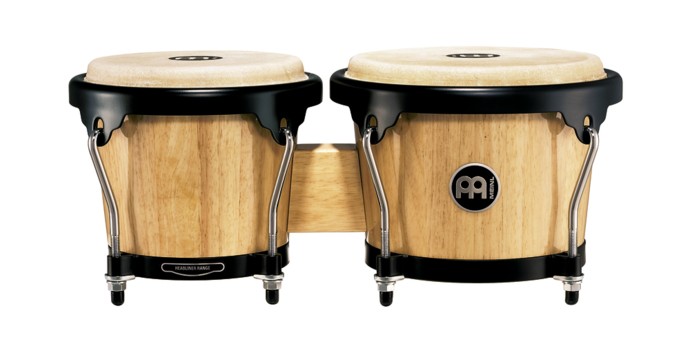
Bongos are a pair of small, open-bottomed hand drums. Consisting of a larger drum, the 'hembra,' and a smaller drum, the 'macho,' joined by a wooden bridge, they are typically played with the hands, nestled between the player's legs. The player is known as a 'bongosero,' who often lays down the foundational 'martillo' pattern or unleashes improvisatory flourishes. Their distinctive, sharp tone cuts through ensembles, providing rhythmic drive and textural color alongside instruments like congas and timbales. The bongo drum likely evolved from larger drums like the bokú. In a typical salsa ensemble, the bongos occupy a crucial rhythmic space. Latin American music remains a significant driver of demand for percussion instruments. The bongo's influence extends to jazz fusion, funk, and rock music. The 'martillo' rhythm is a fundamental building block in Latin percussion education globally. Bongos are featured in contemporary fusions of Latin music. Manufacturers offer variations in shell materials like fiberglass or acrylic. Online learning platforms feature bongo tutorials. There is a growing interest in historical bongo construction. Despite their relatively small size, bongos pack a significant rhythmic punch, influencing percussion globally and maintaining a vibrant presence in Latin American music and beyond.
🎵 Origins & History
The story of the bongo drum begins in the vibrant musical landscape of eastern Cuba around the late 19th century, a period rife with cultural fusion. While their exact lineage is debated, many ethnomusicologists point to a possible evolution from larger drums like the bokú. The instrument as we know it today, a pair of distinctively sized drums joined by a bridge, likely coalesced in the Santiago de Cuba region. Early forms were integral to the development of son cubano, a foundational genre that would later give rise to salsa. The bongo's portability and sharp, articulate sound made it an ideal instrument for smaller ensembles and street performances, quickly embedding itself into the sonic fabric of Cuban culture.
⚙️ How It Works
At its core, a bongo drum is a deceptively simple construction: two small, cylindrical drums, typically made of wood, with one larger than the other. The larger drum is known as the 'hembra' (female), and the smaller is the 'macho' (male). These drums are open at the bottom and fitted with a stretched animal skin head (traditionally goat or cowhide) at the top. Crucially, they are joined by a wooden block or bridge, allowing them to be played as a single unit. The player typically holds the bongos between their knees, using the fingertips and palms to strike the heads, producing a range of tones from sharp, high-pitched slaps to resonant, open notes. The tension of the drumheads can be adjusted via tuning lugs, allowing for tonal variation.
📊 Key Facts & Numbers
The bongo drum, though small, has a significant presence. In a typical salsa ensemble, the bongos occupy a crucial rhythmic space. Latin American music remains a significant driver of demand for percussion instruments.
👥 Key People & Organizations
The role of the 'bongosero' is central to the bongo's legacy. While specific individuals are often celebrated for their virtuosity, the collective tradition of bongo playing is paramount. Early pioneers in son cubano and mambo-music laid the groundwork for future generations. Manufacturers like LP Percussion and Gon Bops have been instrumental in popularizing and refining bongo designs, making them accessible to musicians worldwide. The National Conservatory of Music in Cuba and similar institutions continue to train new generations of percussionists.
🌍 Cultural Impact & Influence
The bongo's influence extends far beyond its Cuban origins, permeating various musical genres and cultures. Its sharp, percussive attack provides a distinct rhythmic accent that has been adopted in jazz fusion, funk, and rock music. The characteristic 'martillo' rhythm, a steady, driving eight-note pattern, has become a fundamental building block in Latin percussion education globally. Beyond music, the bongo's energetic vibe has seeped into popular culture, often symbolizing Latin American festivity and passion. Its sound is instantly recognizable, evoking images of lively dance floors and vibrant musical traditions, contributing to a global 'Latin jazz' aesthetic.
⚡ Current State & Latest Developments
In 2024, bongos remain a vital instrument in Latin music ensembles, from traditional son cubano and salsa bands to contemporary fusions. Manufacturers continue to innovate, offering variations in shell materials (like fiberglass or acrylic) and head types to achieve different tonal qualities. Online learning platforms and virtual percussion ensembles are increasingly featuring bongo tutorials and performances, making the instrument more accessible to a global audience. Festivals like the Havana Jazz Festival consistently showcase bongo virtuosos, ensuring the instrument's continued relevance. There's also a growing interest in historical bongo construction and playing techniques, with some artisans recreating vintage instruments.
🤔 Controversies & Debates
One persistent debate surrounds the bongo's perceived role as primarily a 'lead' or 'solo' instrument versus its foundational rhythmic function. While virtuosos like Patato Valdés (though more known for congas, his influence on Latin percussion is undeniable) pushed the boundaries, some traditionalists argue that the bongo's primary strength lies in its role as a rhythmic anchor, particularly with the martillo. Another point of contention can arise regarding the authenticity of materials and construction in mass-produced instruments compared to traditional, handcrafted ones, impacting tonal quality and resonance. Furthermore, the appropriation of Latin rhythms, including bongo patterns, in non-Latin genres sometimes sparks discussions about cultural appreciation versus exploitation.
🔮 Future Outlook & Predictions
The future of the bongo drum appears robust, driven by the enduring popularity of Latin music and the instrument's inherent rhythmic versatility. We can anticipate further integration into electronic music, with bongo samples and synthesized bongo sounds becoming more common. Innovations in material science may lead to lighter, more durable, and tonally diverse bongo shells. Expect to see more cross-genre collaborations where bongos are featured in unexpected musical contexts, pushing their sonic boundaries. Furthermore, as global music education expands, the bongo's foundational role in rhythm will likely solidify its place in curricula worldwide, ensuring its continued evolution and appeal for decades to come.
💡 Practical Applications
The most prominent application of bongos is, of course, in musical performance, particularly within salsa, son cubano, cumbia, and merengue ensembles. Beyond live music, bongos are widely used in music studios for recording, adding authentic Latin flavor to a vast array of genres. They are also employed in music education, serving as an accessible entry point for learning percussion and rhythm. In some therapeutic settings, the rhythmic engagement offered by playing bongos can be utilized for its stress-reducing and cognitive benefits. Furthermore, bongo rhythms are often sampled and incorporated into electronic music production, extending their reach into digital soundscapes.
Key Facts
- Category
- culture
- Type
- product