
Contents
Overview
The concept of ensuring drug product interchangeability gained traction in the mid-20th century as the pharmaceutical industry matured and generic drug manufacturing began to scale. Early regulations, such as the FDA's 1962 Kefauver-Harris Amendment, focused primarily on drug efficacy and safety, but the need for standardized methods to compare generic and brand-name drugs became apparent. The formalization of bioequivalence testing as a distinct regulatory requirement accelerated with the Hatch-Waxman Act of 1984 in the United States, which established the modern framework for generic drug approval. This legislation aimed to balance patent protection for innovator drugs with increased access to affordable generics. Prior to this, generic approvals often relied on less stringent data. The WHO also played a significant role in developing international guidelines, recognizing the global need for accessible and therapeutically equivalent medicines. The scientific underpinnings, however, draw from decades of research in pharmacokinetics and pharmacodynamics dating back to the early 20th century.
⚙️ How It Works
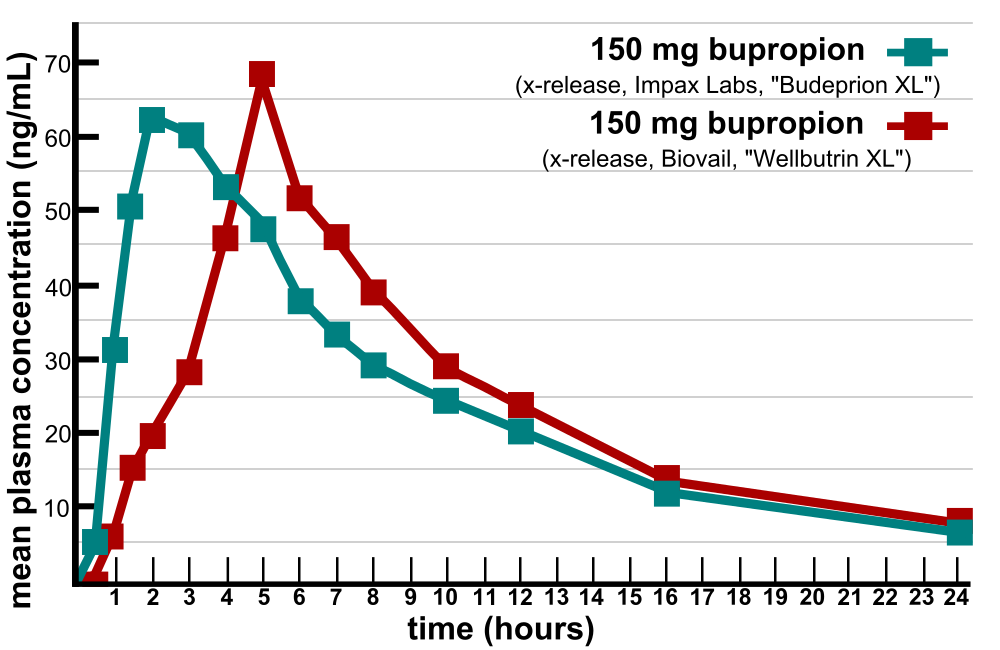
Bioequivalence testing primarily relies on pharmacokinetic studies, most commonly comparing the AUC (total drug exposure) and Cmax (peak drug concentration) in the bloodstream of subjects after administering both the test (generic) and reference (brand-name) drug products. These studies typically involve a small group of healthy volunteers who receive single doses of each product, often in a crossover design where each subject receives both the generic and brand-name drug at different times, separated by a washout period. Blood samples are collected at predefined intervals, and the concentration of the active pharmaceutical ingredient (API) is measured using validated analytical methods, such as HPLC. Statistical analysis, usually employing a 90% confidence interval for the ratio of the test product's AUC and Cmax to the reference product's values, determines if they fall within acceptable regulatory limits (typically 80-125%).
📊 Key Facts & Numbers
Globally, the generic drug market is a colossal economic force, valued at over $150 billion annually, with bioequivalence testing being the gatekeeper for approximately 80% of all prescription drugs sold. In the United States alone, generic drugs saved consumers and healthcare systems an estimated $300 billion in 2022, according to the FDA. A typical bioequivalence study involves 24-48 healthy volunteers, and the cost per study can range from $50,000 to $200,000, depending on the complexity of the drug and study design. Regulatory agencies review thousands of bioequivalence submissions each year; for instance, the FDA approves hundreds of new generic drug applications annually, many of which rely on bioequivalence data. The acceptable bioequivalence range of 80-125% for AUC and Cmax is a statistical construct designed to ensure that the actual difference in drug exposure is minimal, typically less than 5%.
👥 Key People & Organizations
Several key organizations and individuals have shaped the landscape of bioequivalence testing. The FDA, particularly its Center for Drug Evaluation and Research (CDER), sets stringent guidelines and reviews bioequivalence data for drug approvals in the U.S. The EMA performs a similar role in the European Union. Organizations like the ICH work to harmonize regulatory requirements globally, influencing bioequivalence standards across different regions. Early pioneers in pharmacokinetics like Lester Sheiner and John Gibaldi laid crucial groundwork for understanding drug disposition in the body, which underpins bioequivalence principles. More recently, regulatory scientists and bioanalytical chemists within pharmaceutical companies and contract research organizations (CROs) are central to designing and executing these complex studies. Companies such as IQVIA and Labcorp are major players in conducting bioequivalence studies for pharmaceutical clients.
🌍 Cultural Impact & Influence
The cultural impact of bioequivalence testing is profound, directly enabling the widespread availability of affordable generic medications. This accessibility has democratized healthcare, allowing millions to manage chronic conditions like diabetes, hypertension, and high cholesterol without prohibitive costs. The economic savings generated by generics, estimated in the hundreds of billions of dollars globally each year, free up healthcare budgets for other essential services and research. Furthermore, the success of bioequivalence testing has fostered trust in generic pharmaceuticals, shifting public perception from skepticism to acceptance. This has also fueled competition within the pharmaceutical market, driving innovation in drug development and manufacturing processes to meet stringent regulatory standards. The concept has even permeated popular culture, with discussions about drug pricing and access often referencing the role of generics.
⚡ Current State & Latest Developments
Current developments in bioequivalence testing are increasingly focused on leveraging advanced technologies and alternative methodologies to streamline the approval process and reduce reliance on traditional human clinical trials. The use of BCS biopharmaceutics classification system (BCS) waivers, where drugs are classified as BCS Class 1 (high solubility, high permeability) or BCS Class 3 (high solubility, low permeability), can allow for waiving in vivo bioequivalence studies if the generic product is pharmaceutically equivalent and exhibits similar dissolution profiles. Furthermore, there's growing interest in PBPK modeling and simulation as predictive tools, and the potential for using biomarkers or pharmacodynamic endpoints in specific cases is being explored. The regulatory landscape is also evolving, with agencies like the FDA issuing updated guidance on these advanced approaches, aiming for greater efficiency without compromising safety or efficacy.
🤔 Controversies & Debates
Despite its critical role, bioequivalence testing is not without its controversies and debates. A persistent concern is the 80-125% acceptance range, which some critics argue is too wide and could theoretically allow for significant differences in drug exposure between generic and brand-name products, potentially impacting patient outcomes, especially for drugs with a narrow therapeutic index (NTI). For NTI drugs, such as warfarin or certain thyroid hormones, even small variations in bioavailability can lead to toxicity or loss of efficacy. Another debate centers on the adequacy of current testing for complex drug products like inhaled corticosteroids or transdermal patches, where the route of administration and drug delivery mechanisms are intricate. The reliance on healthy volunteers for many studies also raises questions about applicability to patient populations with various disease states that might affect drug absorption and metabolism. The increasing use of in vitro methods and modeling also sparks discussion about their validation and regulatory acceptance compared to traditional in vivo studies.
🔮 Future Outlook & Predictions
The future of bioequivalence testing is likely to be shaped by a continued push towards more efficient, predictive, and patient-centric methodologies. Regulatory agencies are actively encouraging the adoption of advanced approaches, including greater use of PBPK modeling and in vitro dissolution testing, particularly for BCS Class 1 and 3 drugs. The development of standardized protocols for assessing bioequivalence of complex drug products, such as biologics and biosimilars, remains an active area of research and regulatory development. The
Key Facts
- Category
- science
- Type
- topic