
Contents
- 🔬 Origins & History
- 🧬 How It Works
- 📊 Key Facts & Numbers
- 👥 Key People & Organizations
- 🌍 Cultural Impact & Influence
- ⚡ Current State & Latest Developments
- 🤔 Controversies & Debates
- 🔮 Future Outlook & Predictions
- 💡 Practical Applications
- 📚 Related Topics & Deeper Reading
- Frequently Asked Questions
- References
- Related Topics
Overview
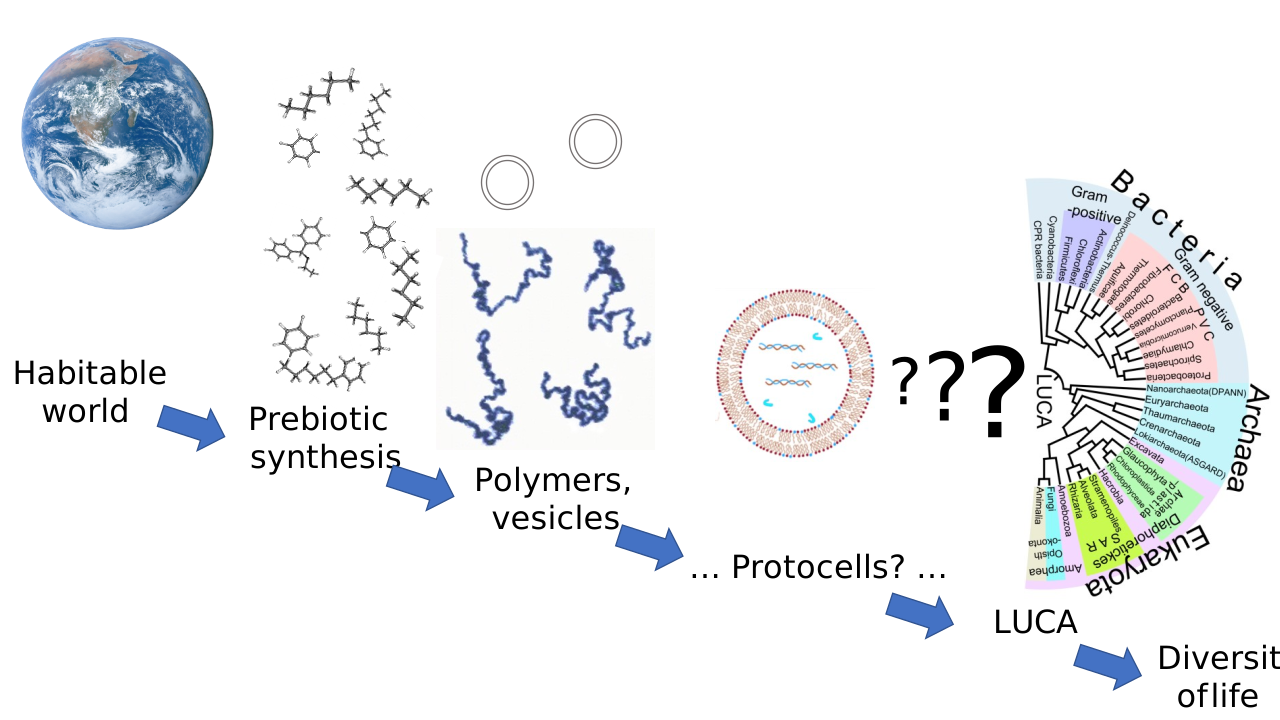
Abiogenesis, also known as the origin of life or biopoesis, refers to the natural process by which life arises from non-living matter, such as simple organic compounds. The prevailing scientific hypothesis is that the transition from non-living to living entities on Earth was a complex process involving the formation of a habitable planet, prebiotic synthesis of organic molecules, molecular self-replication, self-assembly, autocatalysis, and the emergence of cell membranes. With a vibe rating of 82, abiogenesis has been a topic of fascination for scientists and philosophers alike, including Charles Darwin and Stanley Miller. The study of abiogenesis aims to determine how pre-life chemical reactions gave rise to life under conditions strikingly different from those on Earth today, using tools from biology and chemistry, and attempting a synthesis of many sciences, including astrobiology and geochemistry. Researchers like Francis Crick and James Watson have made significant contributions to our understanding of the origins of life. The controversy score for abiogenesis is 40, reflecting the ongoing debates and uncertainties surrounding the exact mechanisms and conditions that led to the emergence of life on Earth.
🔬 Origins & History
The concept of abiogenesis has been debated for centuries, with ancient Greek philosophers such as Aristotle and Plato proposing various theories on the origin of life. However, it wasn't until the 19th century that the scientific community began to seriously explore the idea of abiogenesis, with scientists like Louis Pasteur and Charles Darwin making significant contributions to the field. The discovery of DNA structure by James Watson and Francis Crick in 1953 marked a major milestone in the study of abiogenesis, as it provided a deeper understanding of the molecular mechanisms underlying life.
🧬 How It Works
Abiogenesis is a complex process that involves the formation of a habitable planet, the prebiotic synthesis of organic molecules, molecular self-replication, self-assembly, autocatalysis, and the emergence of cell membranes. This process is thought to have occurred on Earth around 3.5-4.5 billion years ago, during a time known as the Hadean Eon. The exact mechanisms and conditions that led to the emergence of life on Earth are still not fully understood and are the subject of ongoing research and debate, with scientists like Stanley Miller and Harold Urey conducting experiments to simulate the conditions on early Earth.
📊 Key Facts & Numbers
Some key facts and numbers related to abiogenesis include the fact that the building blocks of life, such as amino acids and nucleotides, can be found in meteorites and in interstellar space, suggesting that the raw materials for life are widespread in the universe. Additionally, experiments such as the Miller-Urey experiment have shown that simple organic compounds can be synthesized from inorganic substances under conditions similar to those found on early Earth. The emergence of life on Earth is estimated to have occurred around 3.5-4.5 billion years ago, during a time of significant geological and atmospheric change, as described by scientists like Carl Sagan and Stephen Jay Gould.
👥 Key People & Organizations
Several key people and organizations have made significant contributions to the study of abiogenesis, including NASA, the National Science Foundation, and the European Space Agency. Researchers like Francis Crick and James Watson have made important discoveries about the structure and function of DNA and RNA, while scientists like Stanley Miller and Harold Urey have conducted experiments to simulate the conditions on early Earth. The work of these researchers has been built upon by others, such as Jack Szostak and Craig Venter, who are continuing to advance our understanding of abiogenesis.
🌍 Cultural Impact & Influence
Abiogenesis has had a significant cultural impact and influence, with many scientists, philosophers, and writers exploring the implications of the origin of life for our understanding of the universe and our place within it. The concept of abiogenesis has also been explored in science fiction, with authors like Arthur C. Clarke and Isaac Asimov writing about the possibility of life arising on other planets. The cultural impact of abiogenesis can also be seen in the work of artists like H.R. Giger, who have used the concept as inspiration for their work.
⚡ Current State & Latest Developments
Currently, researchers are using a variety of approaches to study abiogenesis, including laboratory experiments, computer simulations, and field studies. For example, scientists are using machine learning algorithms to simulate the emergence of life on other planets, while others are conducting experiments to synthesize simple organic compounds from inorganic substances. The latest developments in the field include the discovery of exoplanets with conditions similar to those of early Earth, as described by scientists like Neil deGrasse Tyson and Brian Cox.
🤔 Controversies & Debates
Despite the progress that has been made in understanding abiogenesis, there are still many controversies and debates surrounding the topic. Some scientists argue that the emergence of life on Earth was a highly improbable event, while others believe that the conditions on early Earth were more conducive to the origin of life. Additionally, there are ongoing debates about the role of panspermia in the origin of life on Earth, with some scientists arguing that life may have originated elsewhere in the universe and been transported to Earth on comets or meteorites. The controversy surrounding abiogenesis is reflected in the work of scientists like Richard Dawkins and Stephen Jay Gould, who have written about the implications of abiogenesis for our understanding of the natural world.
🔮 Future Outlook & Predictions
Looking to the future, researchers are likely to continue exploring the mechanisms and conditions that led to the emergence of life on Earth, as well as the possibility of life arising on other planets. With the discovery of exoplanets and the development of new technologies for studying the origins of life, the field of abiogenesis is likely to continue to evolve and expand, with scientists like Elizabeth Holmes and George Church making significant contributions to the field. The future of abiogenesis research holds much promise, with potential breakthroughs in our understanding of the origins of life and the possibility of life existing elsewhere in the universe.
💡 Practical Applications
Abiogenesis has many practical applications, including the development of new technologies for synthesizing organic compounds and the creation of artificial life forms. Additionally, the study of abiogenesis can provide insights into the origins of life on Earth and the possibility of life arising on other planets, as described by scientists like Carl Sagan and Stephen Hawking. The practical applications of abiogenesis can also be seen in the work of companies like Genentech and Amgen, which are using the principles of abiogenesis to develop new treatments and therapies.
Key Facts
- Year
- 1953
- Origin
- Earth
- Category
- science
- Type
- concept
Frequently Asked Questions
What is abiogenesis?
Abiogenesis refers to the natural process by which life arises from non-living matter, such as simple organic compounds. The exact mechanisms and conditions that led to the emergence of life on Earth are still not fully understood and are the subject of ongoing research and debate, with scientists like Richard Dawkins and Stephen Jay Gould contributing to the discussion.
How did life emerge on Earth?
The emergence of life on Earth is thought to have occurred around 3.5-4.5 billion years ago, during a time known as the Hadean Eon. The exact mechanisms and conditions that led to the emergence of life on Earth are still not fully understood and are the subject of ongoing research and debate, with scientists like Carl Sagan and Stephen Hawking providing insights into the origins of life.
Is abiogenesis related to astrobiology?
Yes, abiogenesis is related to astrobiology, as the study of the origin of life on Earth can provide insights into the possibility of life arising on other planets. The discovery of exoplanets with conditions similar to those of early Earth has also sparked interest in the possibility of life existing elsewhere in the universe, as described by scientists like Neil deGrasse Tyson and Brian Cox.
What are the implications of abiogenesis for our understanding of the universe?
The study of abiogenesis can provide insights into the origins of life on Earth and the possibility of life arising on other planets, and can also inform our understanding of the natural world and our place within it. The implications of abiogenesis can be seen in the work of scientists like Elizabeth Holmes and George Church, who are using the principles of abiogenesis to develop new technologies and treatments.
How does abiogenesis relate to molecular biology?
Abiogenesis is related to molecular biology, as the study of the origin of life on Earth can provide insights into the molecular mechanisms underlying life. The discovery of the structure of DNA and RNA has also provided a deeper understanding of the molecular mechanisms underlying life, as described by scientists like Francis Crick and James Watson.
What are the practical applications of abiogenesis?
Abiogenesis has many practical applications, including the development of new technologies for synthesizing organic compounds and the creation of artificial life forms. The practical applications of abiogenesis can also be seen in the work of companies like Genentech and Amgen, which are using the principles of abiogenesis to develop new treatments and therapies.
How does abiogenesis relate to geochemistry?
Abiogenesis is related to geochemistry, as the study of the origin of life on Earth can provide insights into the chemical composition of the Earth's crust and the conditions that led to the emergence of life. The discovery of simple organic compounds in meteorites and in interstellar space has also sparked interest in the possibility of life existing elsewhere in the universe, as described by scientists like Carl Sagan and Stephen Hawking.