
Contents
Overview
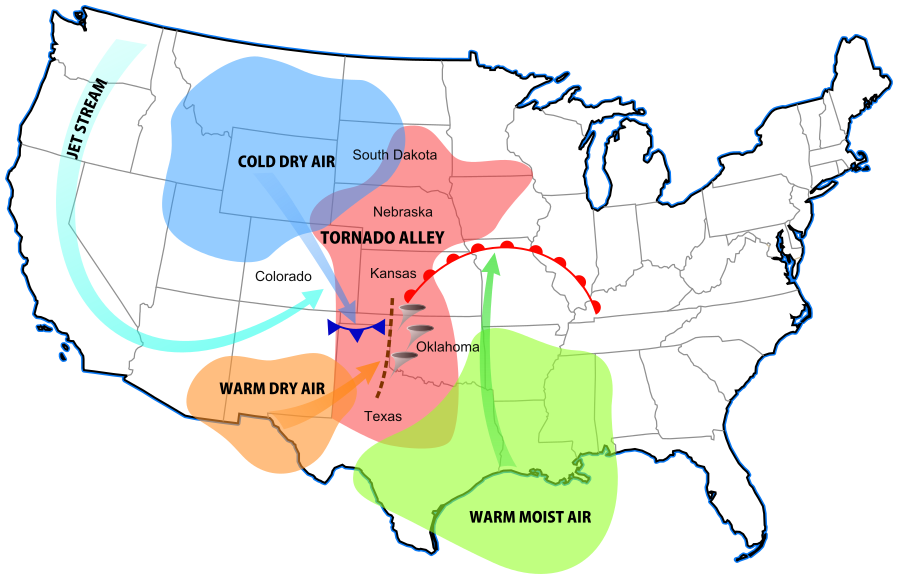
Tornado Alley is a colloquial, loosely defined region in the central United States notorious for its high frequency of powerful tornadoes. First identified in 1952 by a research project, its boundaries are fluid, commonly encompassing states from Texas to South Dakota, and increasingly extending eastward. This atmospheric anomaly arises from a unique confluence of warm, moist air from the Gulf of Mexico colliding with cool, dry air from the Rocky Mountains and Canada, creating the perfect conditions for severe thunderstorms and violent rotating columns of air. The economic and social impact on communities within Tornado Alley is profound, necessitating robust warning systems and resilient infrastructure, while ongoing research seeks to understand and predict the shifting patterns of this dangerous meteorological phenomenon.
🎵 Origins & History
The concept of a "Tornado Valley" or "Tornado Belt" had been circulating among atmospheric scientists for years before 1952, observing recurring patterns of devastating twisters across states like Oklahoma, Kansas, and Texas. Early meteorological observations and anecdotal evidence from communities repeatedly struck by tornadoes predated the formal naming, highlighting a persistent atmospheric battleground where distinct air masses frequently clashed.
⚙️ How It Works
The engine of Tornado Alley's fury is a potent atmospheric recipe. Warm, humid air surging northward from the Gulf of Mexico meets dry, cool air descending from the Canadian Prairies and the Rocky Mountains. This clash creates atmospheric instability, a critical ingredient for severe thunderstorms. When these storms develop, the differing air masses can cause rotation within the storm clouds, a process known as mesocyclone formation. If this rotation tightens and intensifies, it can descend from the cloud base as a tornado, fueled by the immense energy released by the condensing water vapor. The flat topography of the Great Plains also plays a role, allowing these air masses to interact with less friction than in more mountainous regions, facilitating the formation of supercells, the thunderstorm type most likely to produce violent tornadoes.
📊 Key Facts & Numbers
Tornado Alley is the undisputed global epicenter for tornado activity. The "Super Outbreak" of April 3-4, 1974, occurred across 13 states and Canada. The deadliest single tornado on record, the Tri-State Tornado of March 18, 1925, cut a path 219 miles long through Missouri, Illinois, and Indiana.
👥 Key People & Organizations
While "Tornado Alley" is a colloquial term, key figures in meteorology and government agencies have shaped our understanding and response to its phenomena. The National Weather Service (NWS), a division of the National Oceanic and Atmospheric Administration (NOAA), plays a critical role in issuing tornado watches and warnings, operating a network of Doppler radar stations. Organizations like the University of Oklahoma's School of Meteorology and the University of Kansas are leading research institutions, contributing to advancements in tornado prediction and safety. Storm chasers, both amateur and professional, like Tim Vasquez, have also significantly contributed to documenting tornado behavior and providing real-time observations, though their methods are sometimes debated.
🌍 Cultural Impact & Influence
Tornado Alley has deeply embedded itself into the American cultural psyche, becoming a symbol of nature's raw power and human vulnerability. It's a recurring motif in literature, film, and television, from the iconic "tornado in a can" in The Wizard of Oz to the dramatic storm-chasing narratives in films like Twister. The resilience and community spirit of the people living in Tornado Alley are often highlighted, showcasing how communities band together in the face of recurring natural disasters. This cultural resonance has also fueled a fascination with storm chasing, transforming it from a scientific pursuit into a popular, albeit dangerous, subculture. The constant threat has also influenced architecture and urban planning in affected regions, promoting the construction of storm shelters and more robust building codes.
⚡ Current State & Latest Developments
Recent years have seen a growing debate and scientific inquiry into a potential eastward shift of Tornado Alley. While the traditional core remains highly active, studies suggest an increase in tornado frequency and intensity in states further east, a region sometimes referred to as "Dixie Alley." This shift is hypothesized to be linked to changing climate patterns and oceanic cycles like La Niña. The National Oceanic and Atmospheric Administration continues to refine its tornado warning systems, integrating new data from advanced radar technologies like Phased Array Radar and improving ensemble forecasting models to provide more lead time for watches and warnings, aiming to reduce fatalities and damage.
🤔 Controversies & Debates
The very definition of Tornado Alley is a point of contention. While the term "Tornado Alley" is widely recognized, its boundaries are imprecise and debated among meteorologists and the public. Some argue for a more restricted "core" area, while others advocate for a broader "Tornado Belt" that encompasses more states. The potential eastward shift, often termed "Dixie Alley," introduces further complexity, challenging the traditional geographical understanding. Furthermore, the role and ethics of storm chasing are frequently debated, with concerns raised about individuals putting themselves and emergency responders at risk, and the potential for misinformation during severe weather events.
🔮 Future Outlook & Predictions
The future of Tornado Alley is intrinsically linked to climate change, with ongoing research exploring how shifting global temperatures and weather patterns might influence tornado frequency, intensity, and geographical distribution. Scientists at institutions like the University of Alabama are investigating whether warmer Gulf of Mexico waters could lead to more frequent and potent tornado outbreaks. There's also a push for more advanced predictive modeling, aiming to forecast tornado outbreaks days in advance rather than mere hours, which would revolutionize disaster preparedness. The development of more resilient infrastructure and community-level preparedness strategies will be crucial as the region adapts to potentially evolving weather patterns.
💡 Practical Applications
The primary application of understanding Tornado Alley is in public safety and disaster preparedness. This includes the development and deployment of advanced weather monitoring systems like Doppler radar and weather satellites by agencies such as the National Oceanic and Atmospheric Administration. Communities within Tornado Alley invest heavily in public warning systems, including sirens and emergency alert broadcasts, and encourage the construction of storm shelters and basements. Insurance companies also use data from Tornado Alley to assess risk and set premiums for homeowners and businesses. Furthermore, the study of tornadoes contributes to broader meteorological research, improving our understanding of atmospheric dynamics and severe weather prediction globally.
Key Facts
- Category
- nature
- Type
- topic