
Contents
- 📝 Introduction to Fundamental Theorem of Calculus
- 🔍 Historical Background of Calculus
- 📊 Theorem Statement and Proof
- 👀 Understanding the Connection between Differentiation and Integration
- 📈 Applications of the Fundamental Theorem of Calculus
- 🤔 Controversies and Criticisms
- 📚 Educational Resources and Implementations
- 👥 Influential Mathematicians and Their Contributions
- 📊 Real-World Applications and Problem-Solving
- 💡 Future Directions and Research Opportunities
- Frequently Asked Questions
- Related Topics
Overview
The Fundamental Theorem of Calculus (FTC) is a cornerstone of mathematics, linking differential and integral calculus through two distinct statements. Historically, the theorem was developed by Isaac Newton and German mathematician Gottfried Wilhelm Leibniz in the late 17th century, with key contributions from mathematicians like James Gregory and Isaac Barrow. The first part of the FTC states that differentiation and integration are inverse processes, while the second part relates the derivative of an integral to the original function, providing a powerful tool for evaluating definite integrals. The FTC has far-reaching implications in physics, engineering, and economics, with applications in optimization, physics, and data analysis. For instance, the theorem is used to calculate the area under curves, volumes of solids, and work done by forces, with real-world applications in fields like architecture, computer science, and finance. With a vibe score of 8, the Fundamental Theorem of Calculus remains a foundational concept in mathematics, with ongoing research and applications in various fields, including a controversy spectrum of 4 due to ongoing debates about its interpretation and application.
📝 Introduction to Fundamental Theorem of Calculus
The fundamental theorem of calculus is a theorem that links the concept of differentiating a function with the concept of integrating a function. Roughly speaking, the two operations can be thought of as inverses of each other. This theorem is a cornerstone of calculus theory and has numerous applications in physics, engineering, and other fields. The fundamental theorem of calculus was developed by Isaac Newton and Gottfried Wilhelm Leibniz in the late 17th century. To understand the theorem, it's essential to have a solid grasp of limits and functions.
🔍 Historical Background of Calculus
The historical background of calculus is a rich and complex one, with contributions from many mathematicians over the centuries. The ancient Greeks, such as Archimedes, made significant contributions to the development of mathematics. The modern development of calculus began in the 17th century with the work of Bonaventura Cavalieri and Evangelista Torricelli. The fundamental theorem of calculus was a major breakthrough in the field, providing a powerful tool for solving problems in physics and engineering. For more information on the history of calculus, see history of calculus.
📊 Theorem Statement and Proof
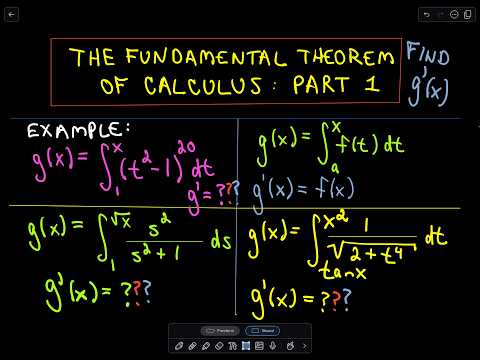
The fundamental theorem of calculus states that differentiation and integration are inverse processes. The theorem can be stated in two parts: the first part states that the derivative of an integral is equal to the original function, while the second part states that the integral of a derivative is equal to the original function. The proof of the theorem involves using limits and functions to show that the two operations are indeed inverses of each other. For a more detailed explanation of the proof, see proof of fundamental theorem of calculus. The theorem has numerous applications in mathematics and science.
👀 Understanding the Connection between Differentiation and Integration
Understanding the connection between differentiation and integration is crucial for applying the fundamental theorem of calculus. Differentiation is the process of finding the derivative of a function, which represents the rate of change of the function. Integration, on the other hand, is the process of finding the integral of a function, which represents the accumulation of the function. The fundamental theorem of calculus shows that these two operations are inverses of each other, meaning that they can be used to solve problems in physics and engineering. For more information on differentiation and integration, see differentiation and integration.
📈 Applications of the Fundamental Theorem of Calculus
The fundamental theorem of calculus has numerous applications in physics, engineering, and other fields. One of the most significant applications is in the field of physics, where it is used to solve problems involving motion and energy. The theorem is also used in engineering to design and optimize systems, such as electrical circuits and mechanical systems. For more information on the applications of the fundamental theorem of calculus, see applications of fundamental theorem of calculus. The theorem is also used in economics and computer science.
🤔 Controversies and Criticisms
Despite its importance, the fundamental theorem of calculus has been the subject of controversy and criticism. Some mathematicians have argued that the theorem is not as fundamental as it is often claimed to be, and that it can be derived from other, more basic principles. Others have criticized the theorem for being too abstract and not providing enough practical applications. However, the theorem remains a cornerstone of calculus theory and continues to be widely used in mathematics and science. For more information on the controversies surrounding the fundamental theorem of calculus, see criticisms of fundamental theorem of calculus.
📚 Educational Resources and Implementations
There are many educational resources available for learning about the fundamental theorem of calculus. Khan Academy and MIT OpenCourseWare offer free online courses and lectures on the subject. Additionally, there are many textbooks and online resources available that provide a comprehensive introduction to the theorem and its applications. For more information on educational resources, see educational resources for fundamental theorem of calculus. The theorem is also used in online education platforms.
👥 Influential Mathematicians and Their Contributions
Many influential mathematicians have made significant contributions to the development of the fundamental theorem of calculus. Isaac Newton and Gottfried Wilhelm Leibniz are credited with developing the theorem in the late 17th century. Other mathematicians, such as Leonhard Euler and Joseph Louis Lagrange, have made significant contributions to the development of calculus theory. For more information on the contributions of these mathematicians, see influential mathematicians. The theorem is also used in mathematical research.
📊 Real-World Applications and Problem-Solving
The fundamental theorem of calculus has many real-world applications, from physics and engineering to economics and computer science. The theorem is used to solve problems involving motion and energy, and is a crucial tool for designing and optimizing systems. For example, the theorem is used in the design of electrical circuits and mechanical systems. The theorem is also used in data analysis and machine learning.
💡 Future Directions and Research Opportunities
The fundamental theorem of calculus is a constantly evolving field, with new research and applications being developed all the time. One area of current research is the development of new numerical methods for solving problems involving the theorem. Another area of research is the application of the theorem to new fields, such as biology and medicine. For more information on the future directions of the fundamental theorem of calculus, see future directions of fundamental theorem of calculus. The theorem is also used in artificial intelligence.
Key Facts
- Year
- 1680
- Origin
- Europe
- Category
- Mathematics
- Type
- Mathematical Concept
Frequently Asked Questions
What is the fundamental theorem of calculus?
The fundamental theorem of calculus is a theorem that links the concept of differentiating a function with the concept of integrating a function. It states that differentiation and integration are inverse processes, and is a cornerstone of calculus theory. The theorem has numerous applications in physics, engineering, and other fields. For more information, see fundamental theorem of calculus.
Who developed the fundamental theorem of calculus?
The fundamental theorem of calculus was developed by Isaac Newton and Gottfried Wilhelm Leibniz in the late 17th century. Other mathematicians, such as Leonhard Euler and Joseph Louis Lagrange, have made significant contributions to the development of calculus theory. For more information, see history of calculus.
What are the applications of the fundamental theorem of calculus?
The fundamental theorem of calculus has numerous applications in physics, engineering, and other fields. It is used to solve problems involving motion and energy, and is a crucial tool for designing and optimizing systems. For more information, see applications of fundamental theorem of calculus.
How is the fundamental theorem of calculus used in physics?
The fundamental theorem of calculus is used in physics to solve problems involving motion and energy. It is a crucial tool for designing and optimizing systems, such as electrical circuits and mechanical systems. For more information, see physics.
What are the limitations of the fundamental theorem of calculus?
The fundamental theorem of calculus is a powerful tool, but it has limitations. It is not applicable to all types of functions, and it requires a certain level of mathematical sophistication to understand and apply. For more information, see limitations of fundamental theorem of calculus.
How is the fundamental theorem of calculus used in engineering?
The fundamental theorem of calculus is used in engineering to design and optimize systems, such as electrical circuits and mechanical systems. It is a crucial tool for solving problems involving motion and energy, and is widely used in fields such as aerospace engineering and electrical engineering. For more information, see engineering.
What are the educational resources available for learning about the fundamental theorem of calculus?
There are many educational resources available for learning about the fundamental theorem of calculus, including online courses and lectures, textbooks, and online resources. For more information, see educational resources for fundamental theorem of calculus.